Money Management for Beginners: The Essentials in One Guide
A beginner’s guide to managing money: the right order of priorities, budgeting, emergency funds, debt, credit, investing basics, insurance and avoiding scams.
Money management can feel complicated, but the essentials fit on one page. If you are starting out — or starting over — this guide covers what matters most and the order to tackle it in. Each section links to a deeper guide when you are ready.
The order of priorities
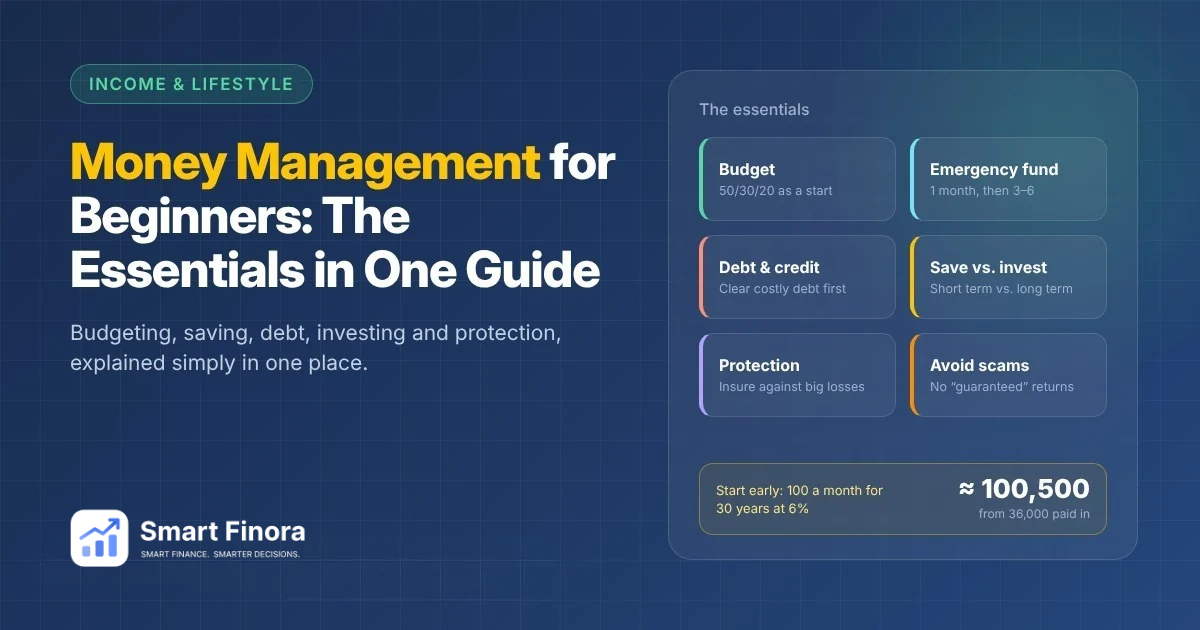
- Make a budget so you know where your money goes.
- Save a starter emergency fund of one month’s essential costs.
- Claim any employer retirement match.
- Pay off high-interest debt.
- Build a full emergency fund of three to six months’ essential costs.
- Save for medium-term goals and invest for the long term.
You can work on several steps at once, but this order protects you from the most common setbacks first.
Budgeting
A budget is a plan for your money. The 50/30/20 rule is a simple starting point: about half of take-home pay for needs, 30% for wants and 20% for savings and extra debt repayment. Track spending for a month or two to see where you really are.
Debt and credit
Not all debt is equal. A low-rate mortgage can be a reasonable way to buy a home; a credit card balance at 20% or more is an emergency. Pay cards in full each month, avoid payday loans, and if you have several debts, use a payoff method to clear them.
Your credit history affects your ability to borrow and the rates you pay. Paying on time, every time, is the single most important habit; how scores are calculated varies by country.
Saving vs investing
Saving is for safety and short-term goals: money in an interest-paying account that you can access. Investing is for long-term goals: money in assets such as diversified funds that can grow faster than inflation, but can also fall in value.
Example
Why starting early matters
Investing 100 a month at an average 6% return for 30 years builds about 100,500 — from 36,000 of your own contributions. The rest is compound growth: returns earning returns. Starting ten years later would leave much less time for that growth.
Explore the effect yourself with the Compound Interest Calculator.
Protection and avoiding scams
Insurance protects you from losses you could not afford, such as illness, accidents or the loss of an income others depend on. What you need depends on your situation and country.
Five terms worth knowing
| Term | Meaning |
|---|---|
| Take-home pay | Income after tax and deductions |
| APR | The yearly cost of borrowing, including some fees |
| Compound interest | Interest earned on previous interest |
| Net worth | What you own minus what you owe |
| Diversification | Spreading money across many investments to reduce risk |
Common mistakes
- Waiting until you “earn enough” to start managing money.
- Saving without an emergency fund first, then borrowing when something goes wrong.
- Carrying credit card balances while saving at low interest.
- Investing money you will need soon.
- Following tips from social media without checking the risks and the source.
Related calculators
Frequently asked questions
Where should a beginner start with money management?
Start with a simple budget and a small emergency fund. Those two steps make everything else easier.
How much money do I need to start investing?
Many platforms let you invest small monthly amounts. Build an emergency fund and clear expensive debt first.
Is it too late to start managing my money?
No. Starting at any age improves your position. The best time was earlier; the second-best time is now.
Sources and references
- Introduction to saving and investing — Investor.gov (US Securities and Exchange Commission)
- Money guidance — MoneyHelper (UK Money and Pensions Service)
- Investor education — Securities and Exchange Board of India
Figures in examples are calculated with Smart Finora’s calculators and rounded. Read how we research and review content in our editorial policy.
Related calculators
Written by
Personal finance writers and editors
The Smart Finora Editorial Team writes and maintains our finance guides. Every guide is researched from primary sources such as government agencies, central banks and regulators, checked against our calculators, and reviewed before publication under our editorial policy.