The 50/30/20 Budget Rule: How It Works and When to Adjust It
How the 50/30/20 rule splits take-home pay into needs, wants and savings, what belongs in each bucket, and how to adapt it when your costs don’t fit.
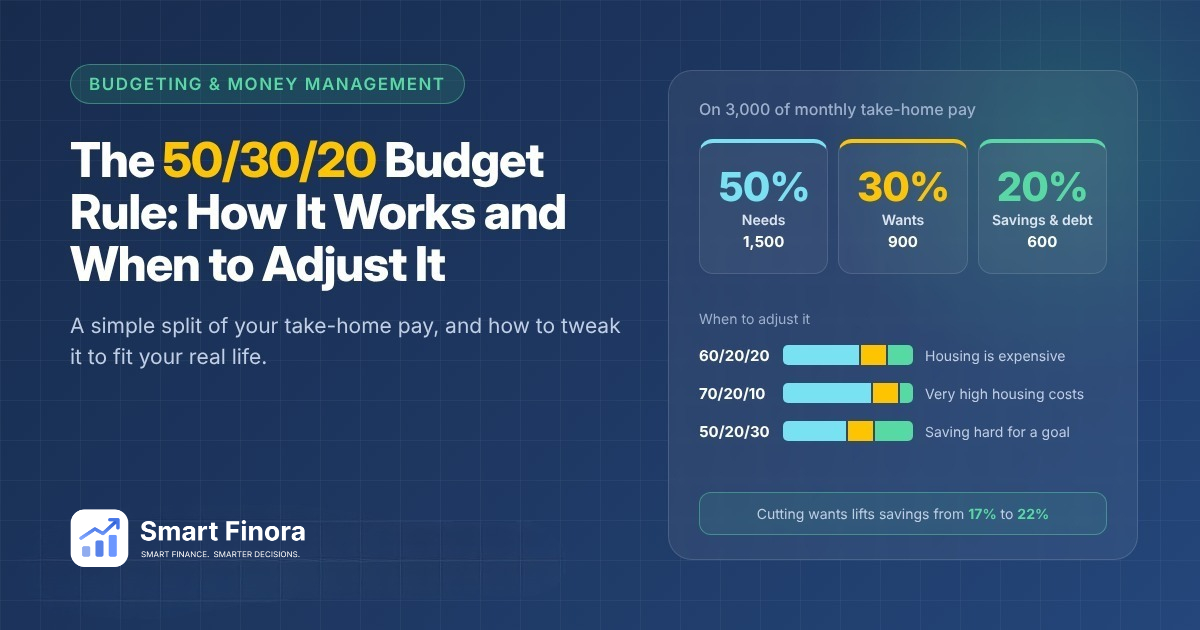
The 50/30/20 rule is popular because it fits on a sticky note: half of your take-home pay for needs, 30% for wants and 20% for your future. It will not suit every household exactly, but it is one of the quickest ways to see whether your spending is roughly in balance — and where to look first if it is not.
How the rule works
Start with your take-home pay — what actually reaches your bank account after tax and other deductions. Then divide it into three buckets:
- 50% for needs: costs you must pay to live and work.
- 30% for wants: spending that makes life more enjoyable but could stop if you had to.
- 20% for savings and debt repayment: emergency savings, investing, retirement top-ups and anything you pay above the minimum on debts.
| Take-home pay | Needs (50%) | Wants (30%) | Savings & debt (20%) |
|---|---|---|---|
| 2,000 | 1,000 | 600 | 400 |
| 3,000 | 1,500 | 900 | 600 |
| 5,000 | 2,500 | 1,500 | 1,000 |
The percentages are a starting point for a conversation with yourself, not a test. Their real value is that they force every unit of income into a category, so nothing quietly disappears.
What goes in each bucket
Needs
Rent or mortgage, utilities, groceries, essential transport, insurance you are required or strongly advised to hold, childcare that lets you work, and the minimum payment on every debt.
Wants
Eating out, takeaways, streaming services, hobbies, holidays, new clothes beyond the basics, and upgrades — the more expensive phone plan, the bigger car, the nicer flat.
Savings and debt repayment
Emergency fund contributions, money for goals, investing, extra pension contributions, and any payment above the minimum on a loan or card. Clearing debt faster improves your future position just as saving does.
A worked example
Example
Checking a real budget against 50/30/20
Take-home pay is 4,200 a month. Needs add up to 2,450 (rent 1,450, utilities 160, groceries 420, transport 190, insurance 110 and a 120 loan minimum) — about 58%. Wants come to 1,050 (25%) and savings to 700 (17%). Needs are high because of rent, which will not change until the lease ends. Trimming wants to 840 by cancelling two subscriptions and eating out less moves savings to 910 — almost 22% — without touching essentials.
Notice what happened: the rule did not demand a cheaper flat overnight. It showed where the flexible money was and made the trade-off visible. You can run the same check with the 50/30/20 Budget Calculator.
When to adjust the percentages
The 50/30/20 split assumes a fairly typical cost of living. Common adaptations include:
- 60/20/20 or 70/20/10 where housing is expensive and needs cannot realistically fit into half of income.
- 50/20/30 if you are saving hard for a deposit or aiming for early financial independence.
- Start at 5–10% savings on a tight income, and raise the share with every pay rise rather than waiting for the perfect budget.
In many countries some saving already happens before you are paid — workplace pension or retirement contributions taken from salary, for example. Because that money never reaches your account, it is not in take-home pay. You can count it as part of your savings share if you want a fuller picture.
Setting it up in five steps
- Find your monthly take-home pay. If your income varies, use a typical low month.
- Go through the last two months of bank and card statements and tag each payment as a need, want or saving.
- Total each group and compare it with 50/30/20, or with the split you have chosen.
- Set up an automatic transfer for your savings share on payday, so saving happens first.
- Review once a month for the first three months, then every quarter.
Common mistakes
- Using gross salary. The rule works on take-home pay; using gross income makes every bucket look bigger than the money you have.
- Counting all debt payments as savings. Only the amount above the minimum belongs in the 20%.
- Forgetting irregular costs. Annual insurance, car repairs and gifts are real needs or wants — divide them by 12 and include them.
- Calling upgrades needs. Be honest about which part of a cost is essential.
- Giving up when the numbers don’t fit. Adjust the split; the habit of allocating every unit matters more than hitting exact percentages.
Related calculators
Frequently asked questions
Is the 50/30/20 rule realistic?
For many people it is a useful target rather than an exact fit. Where rent is high, needs often take 60% or more. The rule still helps by showing how much is left for wants and savings, and by making trade-offs deliberate.
Where does an emergency fund fit?
In the 20% savings bucket. Many people direct the whole 20% to the emergency fund until it reaches a few months of essential costs, then split it between investing and other goals.
Should I include my partner’s income?
If you share costs and goals, budget on household take-home pay. If you keep finances separate, each person can apply the rule to their own income and their share of shared costs.
Sources and references
- Consumer tools: budgeting, saving and debt — Consumer Financial Protection Bureau (US)
- Budgeting and everyday money guidance — MoneyHelper (UK Money and Pensions Service)
- Budgeting and saving — Moneysmart (Australian Securities and Investments Commission)
Figures in examples are calculated with Smart Finora’s calculators and rounded. Read how we research and review content in our editorial policy.
Related calculators
Written by
Personal finance writers and editors
The Smart Finora Editorial Team writes and maintains our finance guides. Every guide is researched from primary sources such as government agencies, central banks and regulators, checked against our calculators, and reviewed before publication under our editorial policy.