Skip to content

50/30/20 Budget Calculator

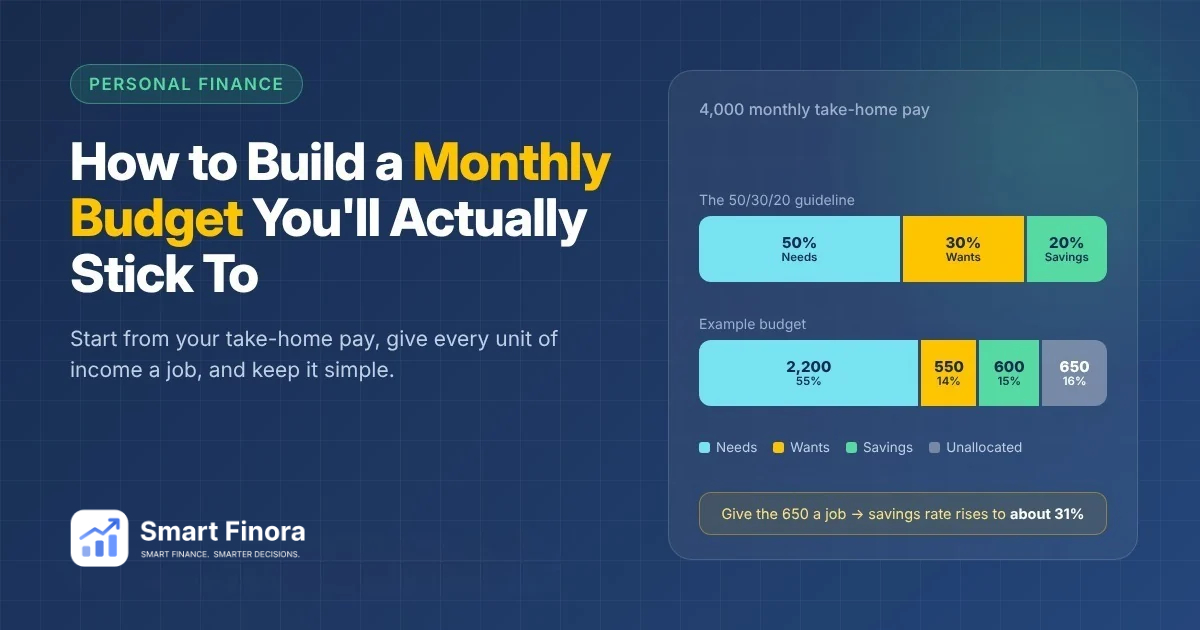
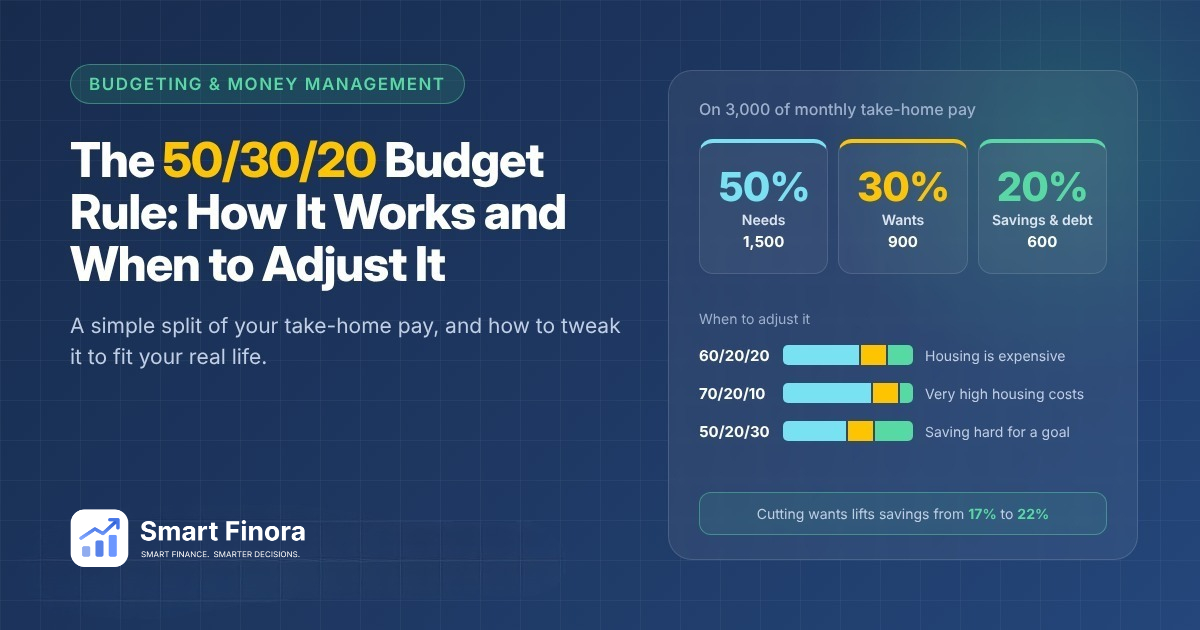
The 50/30/20 rule divides take-home pay into three buckets: about 50% for needs, 30% for wants and 20% for savings and extra debt repayment. Enter your monthly income to see your three budgets. Add what you currently spend in each group to see where you are over or under — and change the percentages if your costs of living call for a different split.

  • Private — runs in your browser
  • Formula explained

Enter your details

$

Pay after tax and deductions — the amount that reaches your account.

Your split (must total 100%)

%
%
%

Your current spending (optional — leave at 0 to skip)

$

Housing, utilities, groceries, transport, insurance, minimum debt payments.

$

Eating out, entertainment, shopping, travel, subscriptions.

$

Savings, investments, pension top-ups and payments above debt minimums.

Calculated in your browser. Your numbers are never sent or stored.

Monthly savings and debt target

$800

Needs budget
$2,000
Wants budget
$1,200
Yearly savings at this rate
$9,600
Your current savings rate
10%
Unallocated each month
$400

Needs are above budget. That is common where housing is expensive; the biggest wins usually come from rent, transport or insurance when contracts renew.

Money that is not allocated tends to disappear. Move it to savings automatically on payday.

Your budget plan
Plan vs. what you spend now

Budget vs. current spending

Swipe the table sideways to see every column.

GroupBudgetNowOver (+) / under (−)
Needs$2,000$2,300$300
Wants$1,200$900-$300
Savings & debt$800$400-$400

How to use the 50/30/20 Budget Calculator

  1. 1Choose your currency and enter your monthly take-home pay.
  2. 2Keep 50/30/20 or adjust the split — for example 60/20/20 in an expensive city.
  3. 3Optionally enter what you spend now on needs, wants and savings.
  4. 4Press Calculate and compare each group with its budget.

Formula

Needs = Income × 50% · Wants = Income × 30% · Savings = Income × 20%

Income
monthly take-home pay (after tax)
Percentages
adjustable; they must add up to 100%

Each bucket is simply your take-home income multiplied by its percentage. “Savings” includes anything that improves your future position: emergency savings, investing, pension top-ups and payments above the minimum on debts. Minimum debt payments count as needs.

Example calculation

On $3,500 a month, the 50/30/20 split gives $1,750 for needs, $1,050 for wants and $700 for savings. Spending $1,900 on needs and $1,150 on wants leaves room to save only $300 — a savings rate of 8.57%, with $150 unallocated that could go straight to savings.

Assumptions and limitations

  • The rule uses take-home pay, not gross salary.
  • Retirement contributions taken from your salary before you are paid are not counted in take-home pay; you may treat them as extra savings.
  • The split is a guideline, not a rule that suits every income or country.

Frequently asked questions

Does the 50/30/20 rule work on a low income?

Often not as written: when essential costs take 70% or more of income, the split becomes unrealistic. Start with what is possible — even 5% saved — and treat 20% as a direction rather than a test you have failed.

Are debt payments needs or savings?

Minimum payments are needs because you must make them. Anything you pay above the minimum reduces debt faster, so it counts towards the 20%.

Should I use gross or net income?

Use net (take-home) income. The rule assumes tax and payroll deductions have already been taken.

Can I change the percentages?

Yes. 60/20/20 or 70/20/10 are common adaptations for high-cost areas. Keep the savings share as high as you reasonably can.

Learn more