Household Budget Planning: Building a Budget for the Whole Home
How to plan a household budget: combine incomes, split shared costs fairly, budget for children and irregular bills, and keep everyone involved.
A household budget is more than a personal budget with bigger numbers. Several people earn, spend and have opinions; some costs are shared and some are personal; and children or other dependants bring expenses that change every year. Here is how to build a budget that works for everyone in the home.
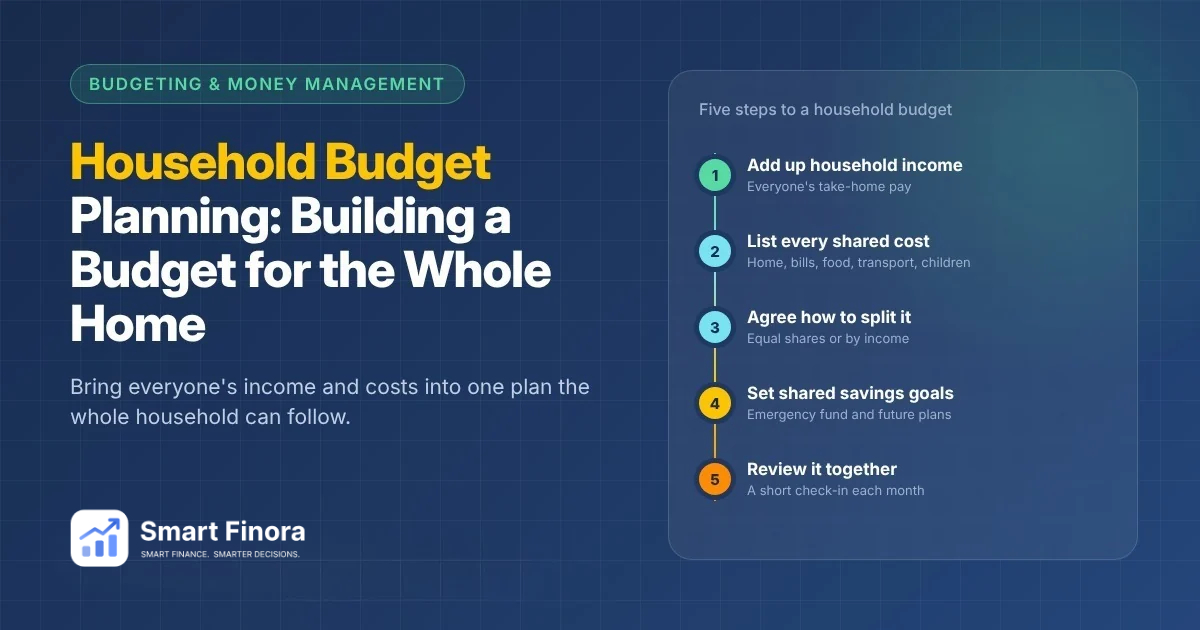
Start with household income
List every regular source of income after tax: salaries, benefits, child-related payments, rental income and side income. If anyone’s income varies, budget on a typical low month and treat anything above it as a bonus for savings or irregular costs.
Agree whether you are budgeting all household income together or only the money each person contributes to shared costs. Both work; what matters is that everyone knows which one you are doing.
Splitting shared costs fairly
Couples and housemates usually choose one of three approaches:
Equal split
Each person pays the same share. Simple, and fair when incomes are similar.
Proportional to income
Each person pays the same percentage of their income. Often fairer when incomes differ.
Example
A proportional split
Two partners take home 3,000 and 2,000 a month — 60% and 40% of the household’s 5,000. Shared costs are 3,000. Paying 60/40 means contributions of 1,800 and 1,200, leaving each with 1,200 and 800 for personal spending and saving. An equal split of 1,500 each would leave 1,500 and 500, which can feel very uneven.
Fully pooled
All income goes into one account and everything is paid from there, often with an agreed personal allowance for each adult. Common for married couples with shared goals.
Building the budget step by step
- Add up household take-home income.
- List fixed shared costs: housing, utilities, insurance, internet, childcare, loan payments.
- Set weekly budgets for variable shared costs such as groceries and fuel.
- Create sinking funds for irregular costs: car repairs, school uniforms, birthdays, festivals, annual fees.
- Agree savings goals — emergency fund first — and automate them.
- Give each adult a personal allowance that needs no explanation.
- Hold a short money check-in once a month.
Planning for children and other dependants
Children’s costs rarely arrive evenly. Childcare may be the largest single cost for a few years, then fall away as school costs, activities and food rise. Plan for predictable spikes — the start of the school year, birthdays, holidays — with sinking funds rather than hoping the month will absorb them.
Many households also support older relatives. If you contribute regularly, include it as a fixed cost; if support is occasional, a dedicated pot avoids difficult choices later. A larger emergency fund is sensible when others depend on your income.
Common mistakes
- One person managing money alone, out of sight. Even if one person handles the admin, both should understand the budget and have access to accounts.
- No personal money. Without an allowance, every small purchase becomes a negotiation.
- Forgetting irregular household costs. Appliances break, cars need servicing and children grow out of shoes.
- Budgeting on the best month’s income. Plan on what you can rely on.
- Not updating after life changes. A new baby, a job change or a move calls for a fresh budget, not small tweaks.
Related calculators
Frequently asked questions
Should couples have joint or separate accounts?
Either can work. Many couples use a joint account for shared costs and keep personal accounts for individual spending — a balance of teamwork and independence.
How do we budget with irregular income?
Budget on your lowest typical month, keep a buffer of one month’s expenses in your current account, and send income above the baseline to savings or sinking funds.
How can we get children involved?
Age-appropriate pocket money, saving for something they want, and simple choices at the shop help children learn that money is finite and choices have trade-offs.
Sources and references
- Household budgeting guidance — MoneyHelper (UK Money and Pensions Service)
- Budgeting and family finances — Moneysmart (Australian Securities and Investments Commission)
Figures in examples are calculated with Smart Finora’s calculators and rounded. Read how we research and review content in our editorial policy.
Related calculators
Written by
Calculator methodology and tax rules
The Smart Finora Research Desk builds and tests the formulas behind our calculators, maintains the country-specific tax tables, and reviews them whenever official rates change. Each calculator documents its formula, assumptions and the date its rules were last reviewed.