Lifestyle Inflation: How to Enjoy Pay Rises Without Losing Them
What lifestyle inflation is, why it happens, what it costs over time, and simple strategies to enjoy rising income while still growing your savings.
Lifestyle inflation — sometimes called lifestyle creep — is when spending rises as fast as income. It explains why many people feel no better off after several pay rises. Some lifestyle growth is the point of earning more; the problem is when it happens automatically and leaves your savings rate stuck.
How lifestyle inflation happens
It rarely comes from one big decision. A nicer flat, a newer car, more meals out, premium subscriptions, more expensive holidays — each feels reasonable on its own. People also adapt quickly: what felt like a treat becomes the new normal within months, so the extra spending stops feeling special.
Fixed commitments are the hardest to reverse. Cancelling a streaming service is easy; moving home or ending a car lease is not.
What it costs over time
Example
Two ways to handle a raise
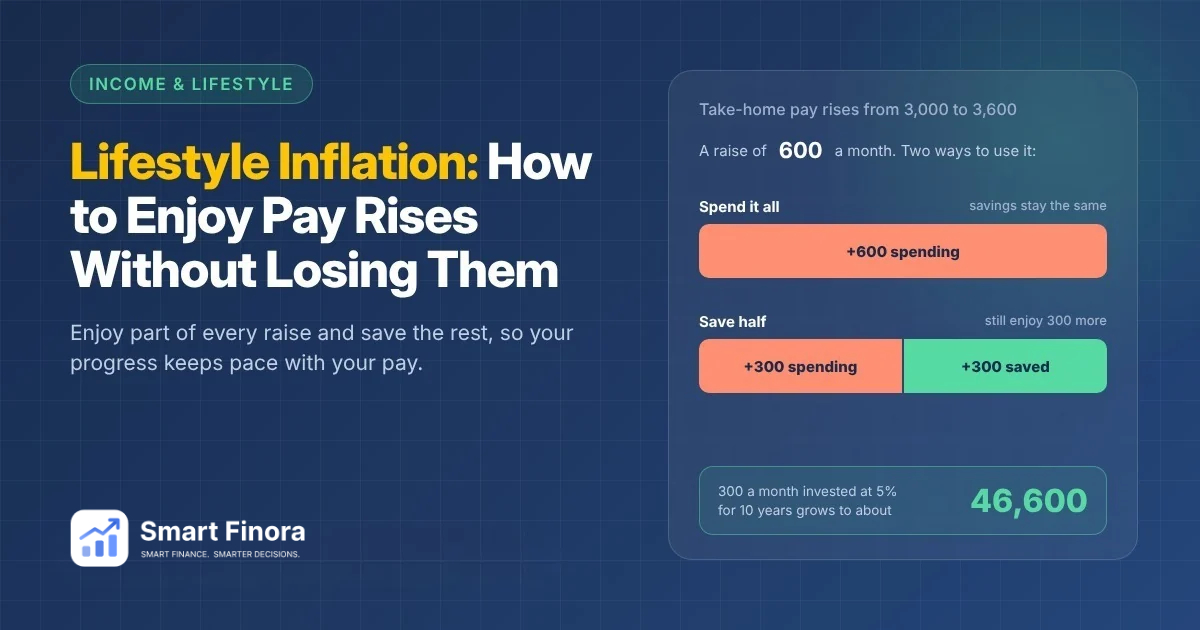
Take-home pay rises from 3,000 to 3,600 a month. If spending rises by the full 600, your savings stay exactly where they were. Saving half the raise instead — 300 a month, or 3,600 a year — and investing it at 5% would build about 46,600 over ten years, while your spending still grows by 300 a month.
Over a career with several raises, the difference compounds into years of extra freedom. The Savings Rate Calculator shows how your savings rate translates into time to financial independence.
Strategies that work
- Save a fixed share of every raise — half is a popular rule — by increasing your automatic transfer on the day the raise starts.
- Upgrade deliberately. Pick one or two areas where spending more genuinely improves your life, and keep the rest the same.
- Be careful with fixed costs. Think twice before committing to higher rent, a bigger mortgage or car finance.
- Wait before upgrading. Live on your old income for three months after a raise, then decide what to change.
- Track your savings rate, not just your balance.
Some lifestyle growth is healthy
The aim is not to live like a student forever. Spending more on things you value — time with family, health, travel, a home that suits you — is part of what earning more is for. The difference is choosing it consciously while still saving a growing amount.
Common mistakes
- Upgrading everything a little, so nothing feels noticeably better.
- Locking in fixed costs that cannot be reduced if income falls.
- Comparing with colleagues or friends instead of your own goals.
- Spending a raise before it arrives, on credit.
- Letting your savings transfer stay the same for years while income grows.
Related calculators
Frequently asked questions
Is lifestyle inflation always bad?
No. Spending more on things that improve your life is reasonable. It becomes a problem when it happens without thought and prevents you from saving more as income grows.
How much of a raise should I save?
Saving half is a simple, popular rule. Saving more speeds up your goals; saving less is still better than nothing.
How do I reverse lifestyle inflation?
Start with flexible costs such as subscriptions and eating out, then review fixed costs at renewal. Redirect every saving to a goal straight away.
Sources and references
- Planning and saving guidance — MoneyHelper (UK Money and Pensions Service)
- Saving and investing basics — Investor.gov (US Securities and Exchange Commission)
Figures in examples are calculated with Smart Finora’s calculators and rounded. Read how we research and review content in our editorial policy.
Related calculators
Written by
Personal finance writers and editors
The Smart Finora Editorial Team writes and maintains our finance guides. Every guide is researched from primary sources such as government agencies, central banks and regulators, checked against our calculators, and reviewed before publication under our editorial policy.