How to Pay Off Debt Faster: Proven Tactics That Work
Practical ways to pay off debt faster: pay more than the minimum, choose a payoff method, lower your interest rates, use windfalls and stop new borrowing.
Getting out of debt faster comes down to two levers: pay more each month, and pay less interest on what you owe. Everything else — methods, apps, challenges — is a way of pulling those two levers more effectively. Here are the tactics that make the biggest difference.
1. Know exactly what you owe
List every debt with its balance, interest rate, minimum payment and due date. Many people find the total lower — or higher — than they feared. Either way, a clear list turns a vague worry into a problem you can plan around.
- Gather your latest statement for every debt.
- Write down each balance, interest rate (APR), minimum payment and due date.
- Add up the minimums: that is the least you must pay each month.
- Decide how much extra you can add, even a small amount.
- Enter it all in the Debt Payoff Calculator to see your debt-free date.
2. Pay more than the minimum
Every extra payment goes straight to principal, which reduces the interest charged in every following month.
Example
The effect of an extra 100 a month
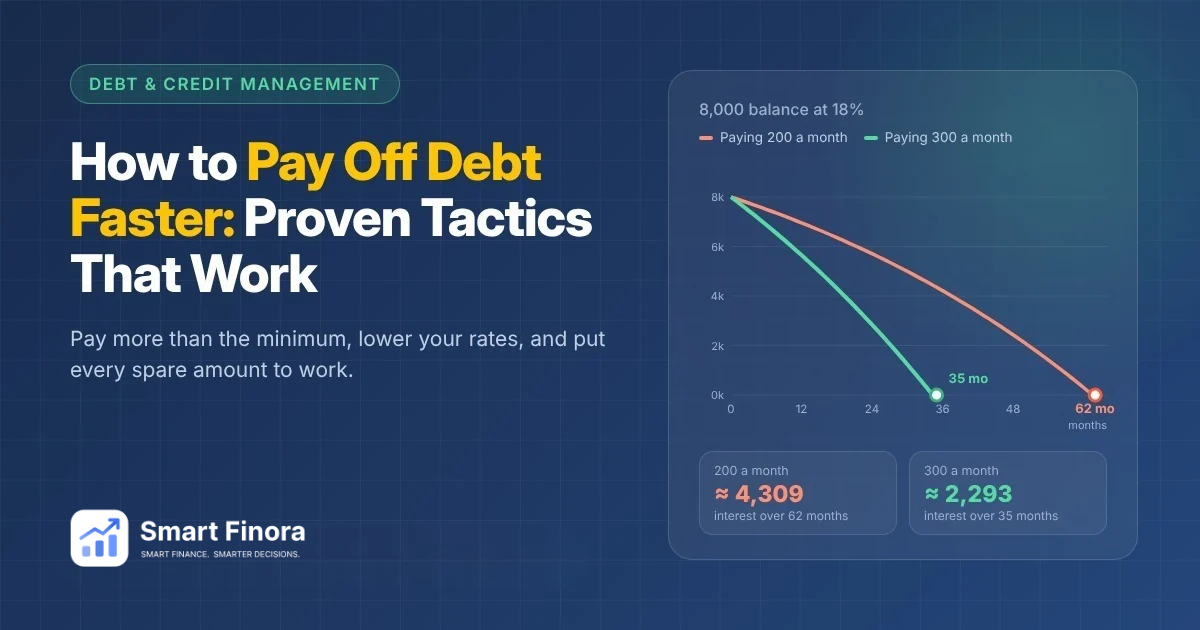
On an 8,000 balance at 18% interest, paying 200 a month takes about 62 months and costs around 4,309 in interest. Paying 300 a month clears it in about 35 months with roughly 2,293 in interest — over two years sooner and about 2,000 cheaper.
3. Choose a payoff order
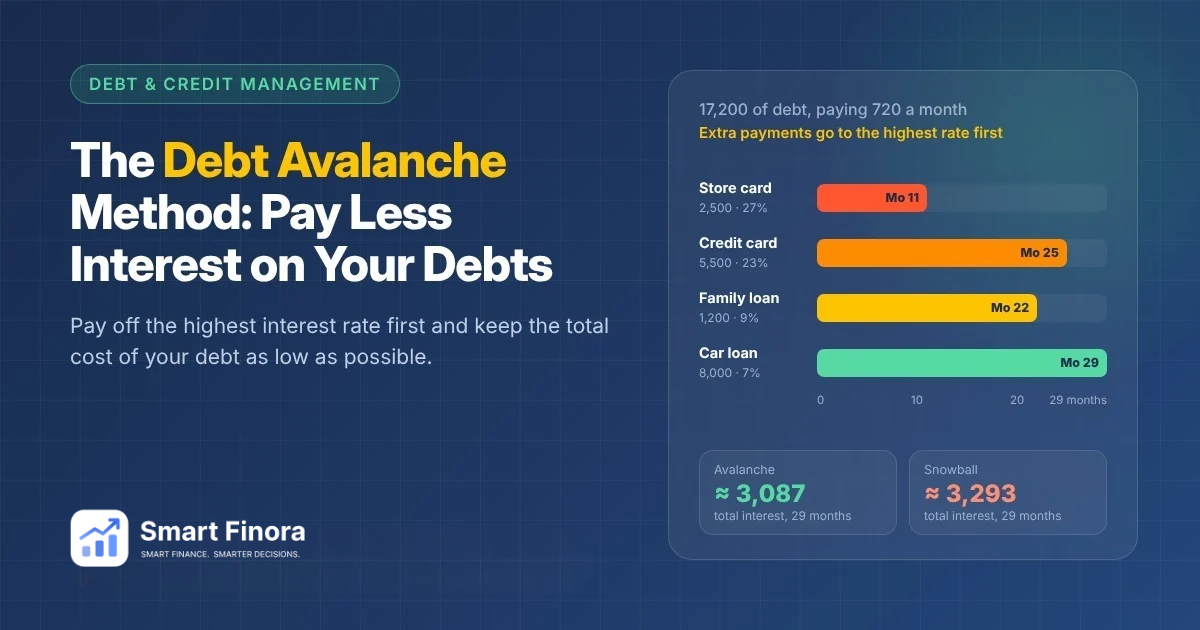
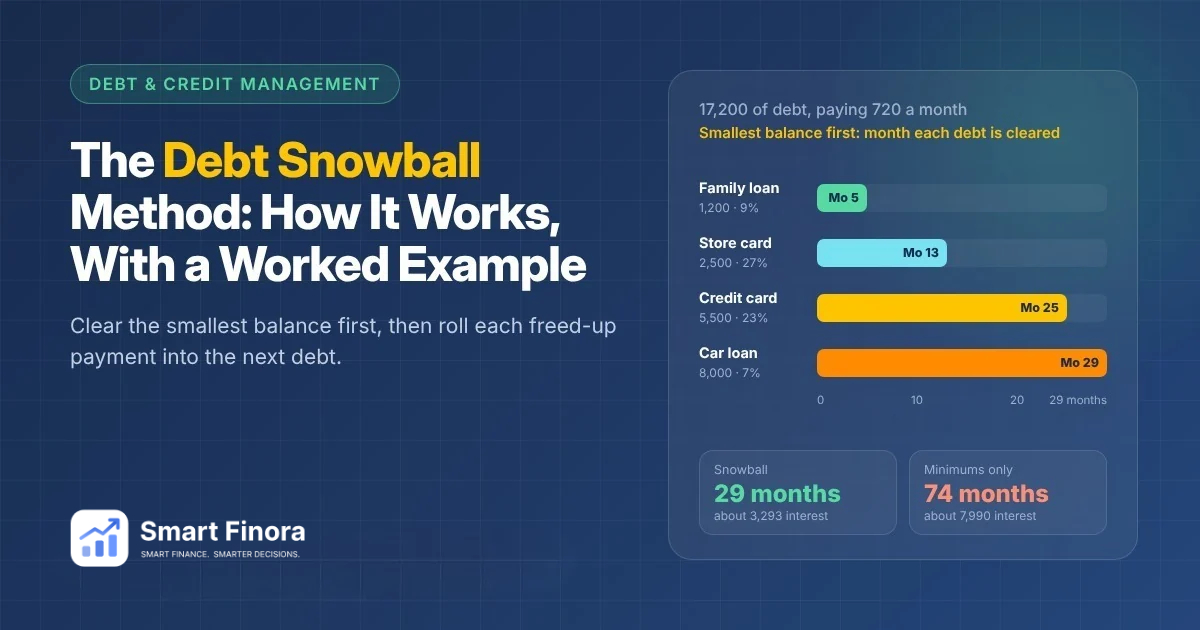
With several debts, focus your extra money on one at a time. The avalanche method (highest rate first) saves the most interest; the snowball method (smallest balance first) gives faster wins. Either way, roll each cleared debt’s payment into the next one.
4. Lower your interest rates
Balance transfers
Moving card debt to a low or 0% introductory rate can save a lot, if you can clear it before the offer ends and the transfer fee is small compared with the interest saved.
Consolidation loans
A personal loan at a lower rate can replace several expensive debts with one fixed payment. Compare the APR including fees, and make sure the term is not so long that you pay more interest overall. The Personal Loan Calculator shows the true cost including fees.
Ask your lender
If you have a good payment record, a lender may lower your rate on request. If you are struggling, ask about hardship arrangements before you miss a payment.
5–8. Find more money and stop the leaks
- Use windfalls. Put tax refunds, bonuses and gifts towards your target debt.
- Pay every two weeks. Paying half your monthly payment every two weeks makes 26 half-payments — 13 full payments a year instead of 12. Check that your lender applies extra payments to principal.
- Redirect cuts. When you cancel a subscription or lower a bill, add the saving to your debt payment immediately so it does not disappear.
- Stop adding new debt. Pause card use while you repay, and build a small emergency fund so surprises do not undo your progress.
Common mistakes
- Consolidating, then running cards up again. You end up with the loan and new card debt.
- Stretching the term to lower the payment. Lower payments over more years often mean more interest.
- Emptying your emergency fund completely. Keep a small buffer so the next surprise doesn’t go on a card.
- Ignoring fees. Transfer, arrangement and early-repayment fees can cancel out savings.
- Waiting too long to ask for help. Lenders usually have more options before payments are missed.
Related calculators
Frequently asked questions
Is it better to pay off debt or invest?
Compare the interest rate on the debt with the return you could realistically expect after tax. Paying off a 20% card is a guaranteed 20% saving, which investments are unlikely to beat. For low-rate debt, investing at the same time can make sense.
Does paying off debt improve my credit score?
Usually, over time. Lower balances and a record of on-time payments are viewed positively by most credit scoring systems.
Should I close accounts once they are paid off?
Not necessarily. Closing cards can affect your available credit and credit history in some scoring systems. If a paid-off card tempts you, lower its limit or remove it from shopping sites instead.
Sources and references
- Consumer tools: debt and credit — Consumer Financial Protection Bureau (US)
- Help with debt — MoneyHelper (UK Money and Pensions Service)
- Debt and borrowing guidance — Financial Consumer Agency of Canada
Figures in examples are calculated with Smart Finora’s calculators and rounded. Read how we research and review content in our editorial policy.
Related calculators
Written by
Personal finance writers and editors
The Smart Finora Editorial Team writes and maintains our finance guides. Every guide is researched from primary sources such as government agencies, central banks and regulators, checked against our calculators, and reviewed before publication under our editorial policy.