The Debt Snowball Method: How It Works, With a Worked Example
How the debt snowball method works step by step, a worked example with four debts, how it compares with the avalanche method and when it is the right choice.
The debt snowball is a simple plan for clearing several debts: pay the minimum on everything, throw every spare unit at the smallest balance, and when it is gone, roll that payment into the next smallest. It does not always save the most interest, but it gives quick wins — and for many people, quick wins are what keep a debt plan alive.
How the snowball works
- List every debt you want to clear, from the smallest balance to the largest. Ignore interest rates for now.
- Decide on one fixed total you will pay towards debts every month: all the minimum payments plus any extra you can find.
- Pay the minimum on every debt, and put all of the extra on the smallest balance.
- When the smallest debt is paid off, add its whole payment to the next smallest.
- Repeat until every debt is gone. Your total monthly payment never goes down — it just moves to the next target.
The “snowball” is that payment: it grows each time a debt disappears, because the money that was going to the cleared debt rolls into the next one.
A worked example
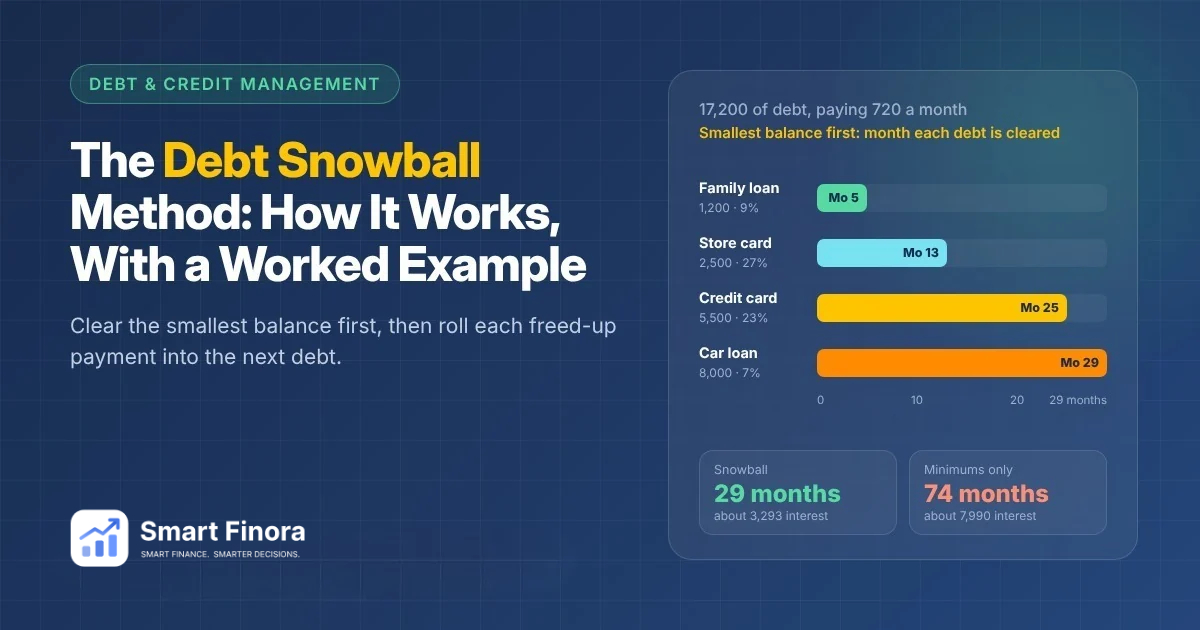
Here are four debts totalling 17,200, with 520 of minimum payments a month. The borrower finds an extra 200, so 720 goes to debt every month.
| Debt | Balance | Interest rate | Minimum | Paid off (snowball) |
|---|---|---|---|---|
| Family loan | 1,200 | 9% | 60 | Month 5 |
| Store card | 2,500 | 27% | 75 | Month 13 |
| Credit card | 5,500 | 23% | 140 | Month 25 |
| Car loan | 8,000 | 7% | 245 | Month 29 |
Example
Snowball result
Following the snowball, the first debt is gone in month 5 and everything is cleared in 29 months, with about 3,293 paid in interest. Paying only the minimums — and not rolling them over — would take about 74 months and cost roughly 7,990 in interest.
Enter your own debts in the Debt Payoff Calculator to see your payoff order and debt-free date.
Why the snowball works for so many people
Paying off a debt completely is satisfying in a way that slowly shrinking a big balance is not. Each closed account means one less bill, one less due date and visible proof that the plan works. That momentum helps people keep going through the long middle stretch, when the last and largest debts are still there.
Fewer debts also means less admin and fewer chances to miss a payment, which can trigger fees and harm your credit record.
Snowball vs avalanche
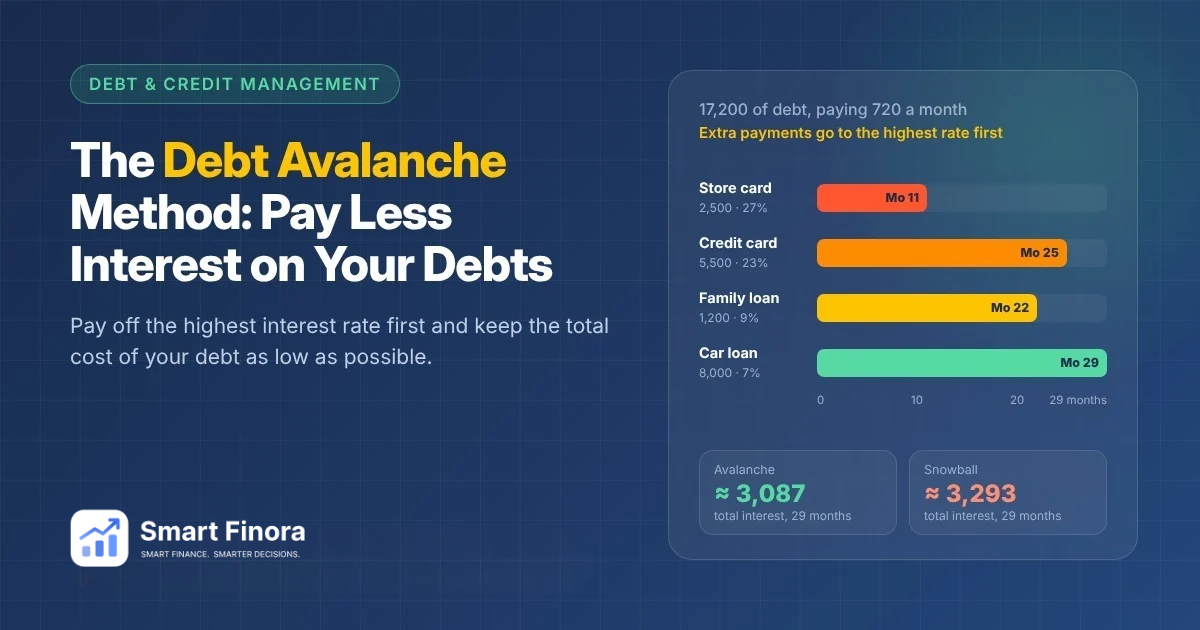
The debt avalanche method targets the highest interest rate first instead. In the example above, avalanche finishes in the same 29 months but costs about 3,087 in interest — around 206 less. The price is patience: its first debt is not cleared until month 11.
Common mistakes
- Not rolling payments over. If you spend the payment freed by a cleared debt, the snowball stops growing.
- Borrowing again. Clearing a card and then using it again restarts the problem. Remove saved card details or lower the limit.
- No emergency buffer. Without a small fund, the next surprise goes straight back on a card.
- Ignoring a huge rate gap. If a large debt charges far more than the others, consider tackling it first or moving it to a lower rate.
- Letting minimums drop. Card minimums often fall as balances fall; keep paying the same total.
Related calculators
Frequently asked questions
Does the debt snowball include my mortgage?
Usually not. The method is designed for consumer debts such as cards, overdrafts, personal loans and car finance. Mortgages have long terms and lower rates.
What if two debts have similar balances?
Put the one with the higher interest rate first. You get the quick win and save a little more interest.
How much extra should I pay each month?
Whatever you can sustain. Even a small extra amount shortens the plan, and it grows as each debt is paid off.
Sources and references
- Consumer tools: debt collection, credit cards and loans — Consumer Financial Protection Bureau (US)
- Help with debt — MoneyHelper (UK Money and Pensions Service)
Figures in examples are calculated with Smart Finora’s calculators and rounded. Read how we research and review content in our editorial policy.
Related calculators
Written by
Calculator methodology and tax rules
The Smart Finora Research Desk builds and tests the formulas behind our calculators, maintains the country-specific tax tables, and reviews them whenever official rates change. Each calculator documents its formula, assumptions and the date its rules were last reviewed.