The Debt Avalanche Method: Pay Less Interest on Your Debts
How the debt avalanche method works, why it saves the most interest, a worked example comparing it with the snowball, and when the difference is worth it.
The debt avalanche is the mathematically cheapest way to clear several debts: pay every minimum, and send all spare money to the debt with the highest interest rate. Because the most expensive balance shrinks first, less interest builds up overall. Here is how it works and how much it can save.
How the avalanche works
- List your debts from the highest interest rate (APR) to the lowest.
- Set a fixed monthly total for debt repayment: all minimums plus any extra.
- Pay the minimum on every debt and put the extra on the highest-rate debt.
- When it is cleared, roll its payment into the next highest rate.
- Continue until all debts are paid.
Every unit you pay towards a 27% card stops 27% interest; the same unit on a 7% car loan stops only 7%. Targeting the highest rate first gives each extra payment the biggest effect.
Worked example: avalanche vs snowball
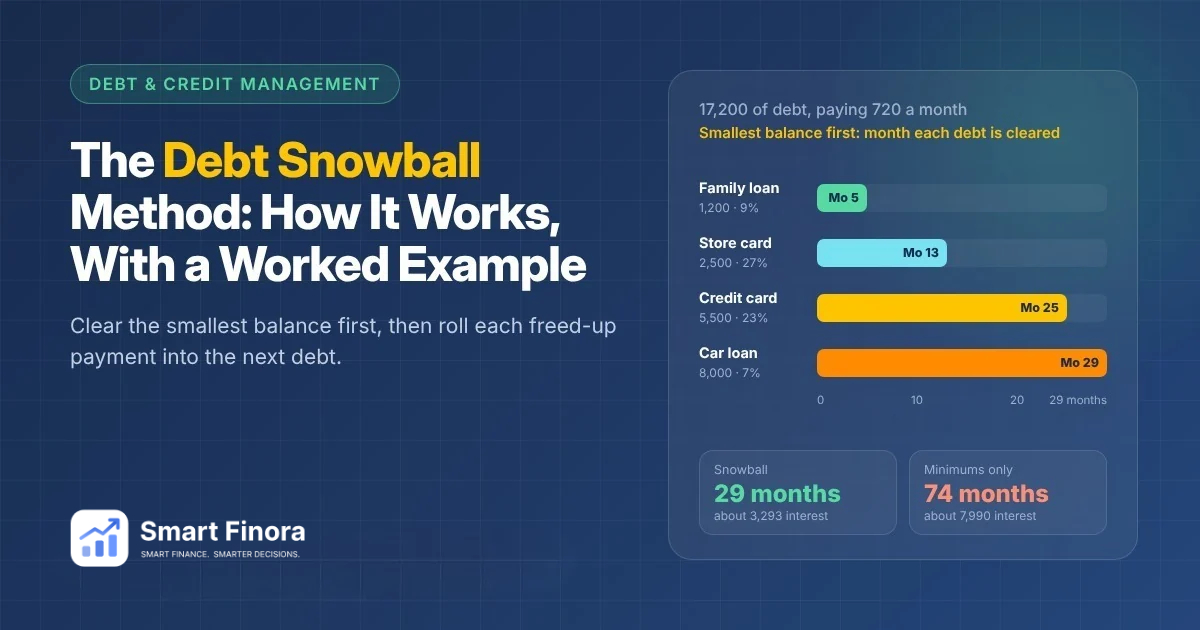
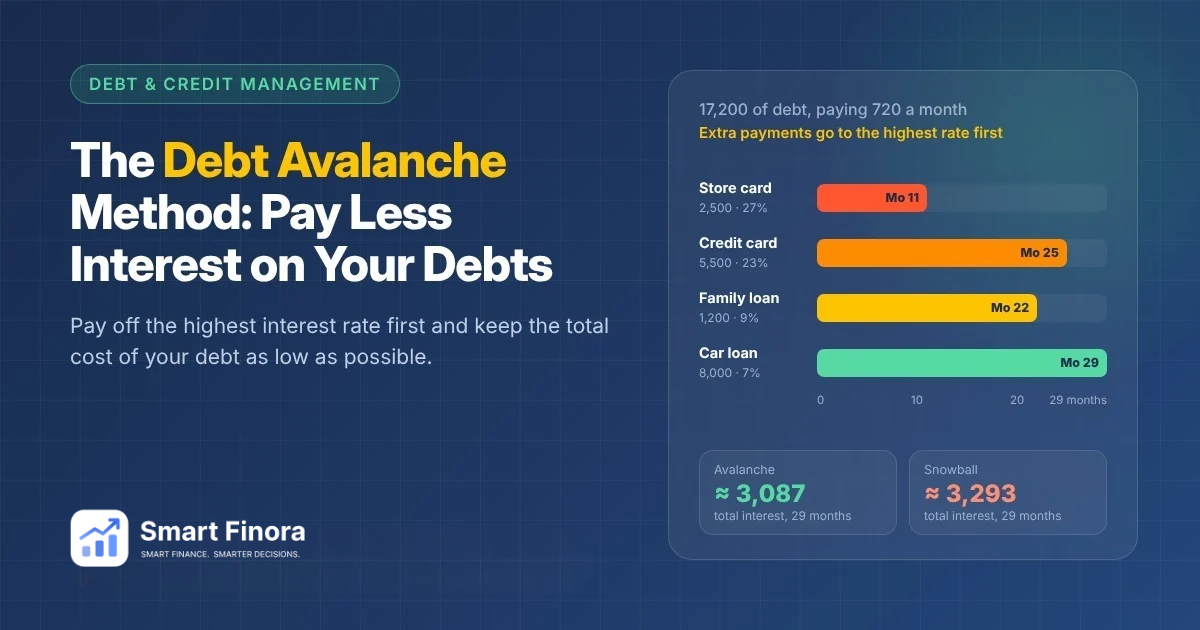
The same four debts as in our snowball guide — 17,200 in total, 520 of minimums plus 200 extra, so 720 a month:
| Debt | Balance | Rate | Paid off (avalanche) | Paid off (snowball) |
|---|---|---|---|---|
| Store card | 2,500 | 27% | Month 11 | Month 13 |
| Credit card | 5,500 | 23% | Month 25 | Month 25 |
| Family loan | 1,200 | 9% | Month 22 | Month 5 |
| Car loan | 8,000 | 7% | Month 29 | Month 29 |
Example
The difference in interest
Both methods clear all four debts in 29 months. The avalanche costs about 3,087 in interest and the snowball about 3,293 — a saving of roughly 206. The family loan, with its small balance but low rate, waits much longer under the avalanche.
The gap grows when rates differ more, balances are larger or the extra payment is small. Compare both methods for your own debts with the Debt Payoff Calculator.
When the avalanche makes the biggest difference
- A large balance at a high rate, such as a big credit card debt alongside a small low-rate loan.
- Wide gaps between rates, for example 25% cards and a 5% car loan.
- Long repayment periods, where interest has more time to build up.
When your debts have similar rates, the two methods give almost the same result, and the motivational edge of the snowball may matter more.
Staying motivated with the avalanche
The avalanche’s weakness is that the first debt can take a long time to disappear. Track the total balance rather than individual accounts, and celebrate milestones such as every 10% of the total paid off.
Common mistakes
- Treating a 0% promotional rate as permanently cheap. Note when the offer ends and what the rate becomes; reorder your list then.
- Ignoring fees. Annual fees or penalty rates can make a debt more expensive than its headline APR suggests.
- Not updating the order. If a rate changes, re-sort your list.
- Paying the minimum on the target debt. All the extra must go to one debt for the method to work.
- Giving up before the first payoff. Expect the first win to take longer than with a snowball.
Related calculators
Frequently asked questions
Is the avalanche always cheaper than the snowball?
It never costs more interest when payments are the same, but the difference can be tiny. Sometimes both methods produce the same order, for example when the smallest debt also has the highest rate.
Should I prioritise a debt with a penalty rate?
Yes. Use the rate you are actually being charged, including any penalty rate after a missed payment.
Can I combine the avalanche with a balance transfer?
Yes. Moving a high-rate balance to a lower rate reduces interest further, as long as you account for the transfer fee and the date the promotional rate ends.
Sources and references
- Consumer tools: credit cards and loans — Consumer Financial Protection Bureau (US)
- Managing debt — Moneysmart (Australian Securities and Investments Commission)
Figures in examples are calculated with Smart Finora’s calculators and rounded. Read how we research and review content in our editorial policy.
Related calculators
Written by
Calculator methodology and tax rules
The Smart Finora Research Desk builds and tests the formulas behind our calculators, maintains the country-specific tax tables, and reviews them whenever official rates change. Each calculator documents its formula, assumptions and the date its rules were last reviewed.