How to Build Savings From Scratch
A step-by-step way to start saving when you have little or nothing put aside: pay yourself first, start small, choose the right account and keep going.
If saving has never stuck for you, the problem is rarely willpower. It is usually the order of operations: spend first, save what is left, and discover there is nothing left. Building savings from scratch is mostly about reversing that order and making the right action automatic.
Pay yourself first
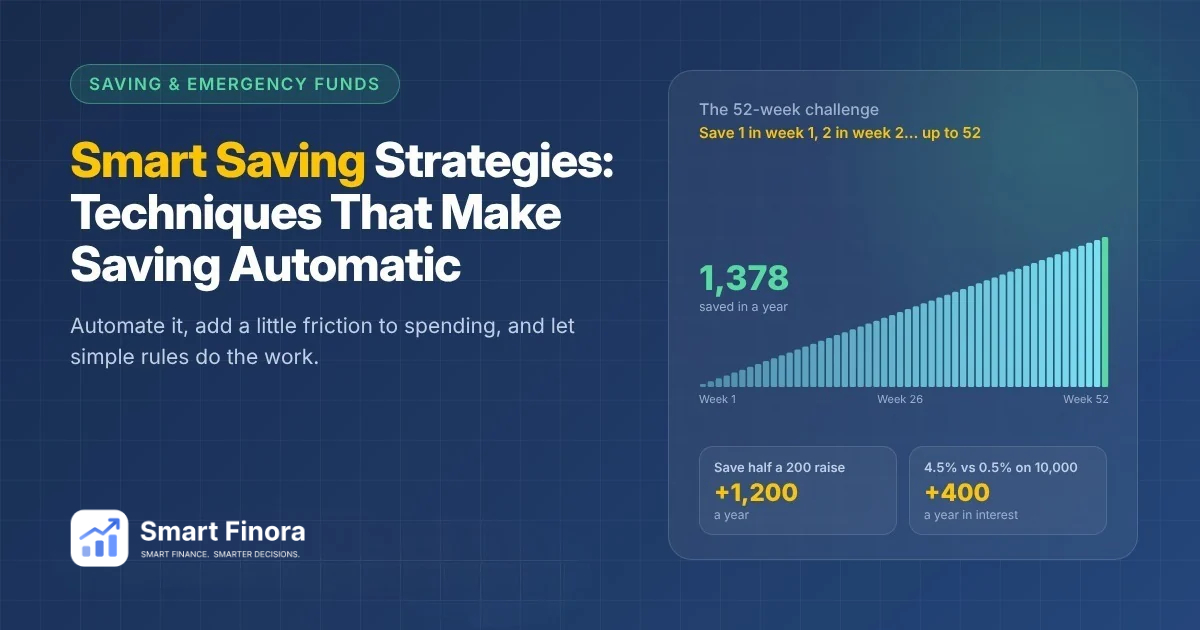
Set up a standing order or automatic transfer that moves money to savings on the day you are paid. You then budget with what remains. Because the money leaves before you can spend it, saving no longer depends on how disciplined you feel at the end of the month.
If your employer can split your salary between two accounts, ask for part of it to go straight into savings. Money you never see is the easiest money to save.
Start smaller than you think you should
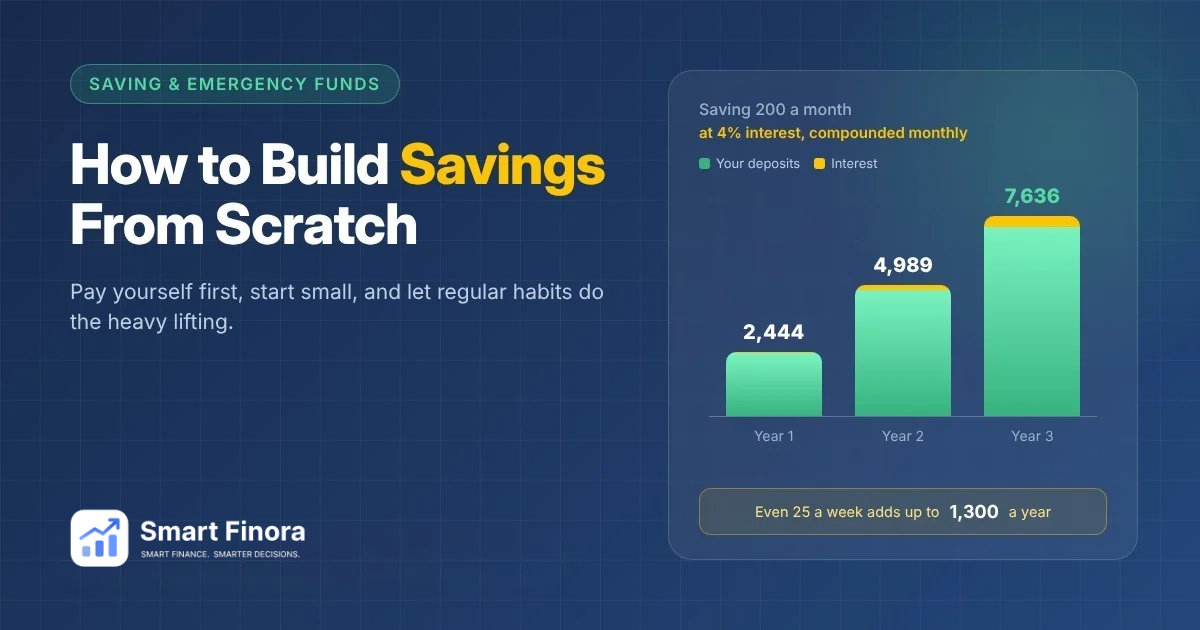
A small amount saved every week beats a big plan that fails in month two. Saving 25 a week builds 1,300 in a year. Once that feels normal, raise it — by 1% of your pay every few months, or by part of every pay rise.
Example
What steady saving adds up to
Saving 200 a month for three years in an account paying 4% interest, compounded monthly, gives about 7,636: 7,200 of your own money and roughly 436 of interest. The interest helps, but the habit does the heavy lifting.
Try your own numbers in the Savings Goal Calculator.
Where to keep your savings
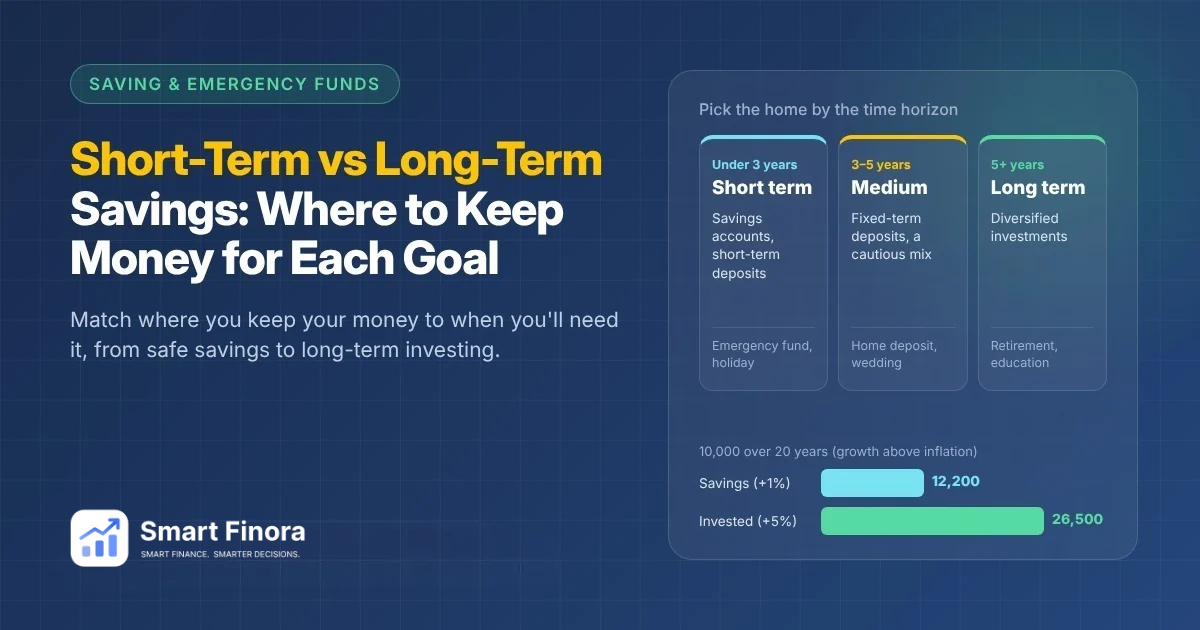
Keep savings separate from your everyday account, ideally at a different bank or in an account without a card attached, so it is not one tap away. For money you may need within a few years, choose safety and easy access over high returns.
Product names differ by country: easy-access savings accounts and cash ISAs in the UK, high-yield savings accounts in the US, savings accounts and recurring or fixed deposits in India, and high-interest savings accounts in Canada and Australia. Compare interest rates, any limits on withdrawals, and whether deposits are covered by your country’s deposit protection scheme.
A sensible order for your savings
- Starter emergency fund: about one month of essential costs, so a surprise bill does not go on a card.
- Employer retirement match: if your employer matches contributions, contribute enough to get the full match — it is part of your pay.
- High-interest debt: clear credit cards and other expensive borrowing.
- Full emergency fund: three to six months of essential costs.
- Goals: a home deposit, a car, education, a big trip.
- Long-term investing: for retirement and financial independence.
Keeping the habit going
- Save windfalls. Put at least half of any bonus, tax refund or gift straight into savings.
- Name your pots. “Emergency fund” or “Lisbon 2027” is harder to raid than “Savings 2”.
- Make progress visible. Check your savings balance monthly — watching it grow is motivating.
- Restart fast. If you have to dip into savings, restart the transfer next payday rather than waiting for the perfect moment.
Common mistakes
- Saving what is left over. There is rarely anything left. Save first.
- Keeping savings in your current account. It gets spent without you noticing.
- Saving while carrying expensive debt. Beyond a starter fund, paying off a 25% card usually beats earning 4% interest.
- Vague goals. “Save more” is hard to measure; “3,000 by December” is not.
- Treating savings as a spending buffer. Dipping in for wants teaches you that savings are optional.
Related calculators
Frequently asked questions
How much should I save each month?
A common target is 10–20% of take-home pay. If that is not possible now, start with any fixed amount and increase it regularly. Consistency matters more than the starting figure.
Should I save or invest?
Save money you will need within about five years and your emergency fund. Invest for goals that are further away, where you can ride out market falls.
What if I can’t afford to save anything?
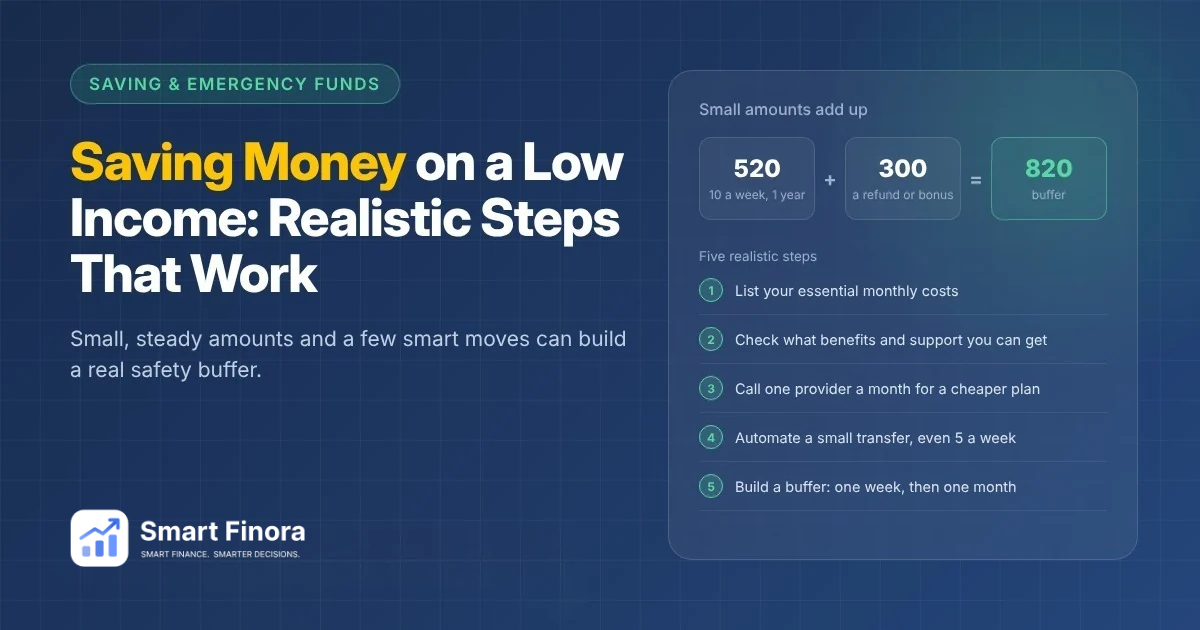
Start by reviewing recurring bills and checking whether you are entitled to any support. Our guide to saving on a low income has practical steps.
Sources and references
- Savings guidance — MoneyHelper (UK Money and Pensions Service)
- Consumer tools: saving — Consumer Financial Protection Bureau (US)
Figures in examples are calculated with Smart Finora’s calculators and rounded. Read how we research and review content in our editorial policy.
Related calculators
Written by
Personal finance writers and editors
The Smart Finora Editorial Team writes and maintains our finance guides. Every guide is researched from primary sources such as government agencies, central banks and regulators, checked against our calculators, and reviewed before publication under our editorial policy.