
Everyday Money Management
Reducing Daily Expenses: Small Changes That Really Add Up
How to reduce daily expenses without feeling deprived: track a week, target repeated costs, swap rather than give up, and send every saving to a goal.
2 min read
Whether it is a home deposit, a car, education or a holiday, a clear target makes saving easier. Enter your goal, what you have saved already, the interest rate you expect and your timeline to find the monthly amount needed.
$464.77
Swipe the table sideways to see every column.
| Year | Total deposited | Balance |
|---|---|---|
| 1 | $7,577 | $7,762 |
| 2 | $13,154 | $13,759 |
| 3 | $18,732 | $20,000 |
PMT = (Goal − S × (1 + i)ⁿ) × i ÷ [(1 + i)ⁿ − 1]
First the calculator works out what your current savings will grow to by the deadline. The remaining gap is then divided into equal monthly deposits made at the end of each month, each earning interest until the goal date. With 0% interest the deposit is simply the gap ÷ n.
To reach $15,000 in 3 years in an account paying 4%, you need to save about $392.86 a month. You deposit $14,143 in total and interest supplies the remaining $857.
Extend the timeline, lower the target, or look for a higher-interest account. Even saving part of the amount builds momentum.
For goals within a few years, many people prefer low-risk options such as high-yield savings accounts or fixed deposits, since investment values can fall in the short term.
In most countries interest is taxable income, sometimes above a tax-free allowance. The results here are before tax, so your actual return may be lower.
Everyday Money Management
How to reduce daily expenses without feeling deprived: track a week, target repeated costs, swap rather than give up, and send every saving to a goal.
2 min read

Family & Future Planning
Financial planning for marriage: the money conversations to have, joint vs separate accounts, budgeting for the wedding, and updating protection and paperwork.
2 min read
Saving & Emergency Funds
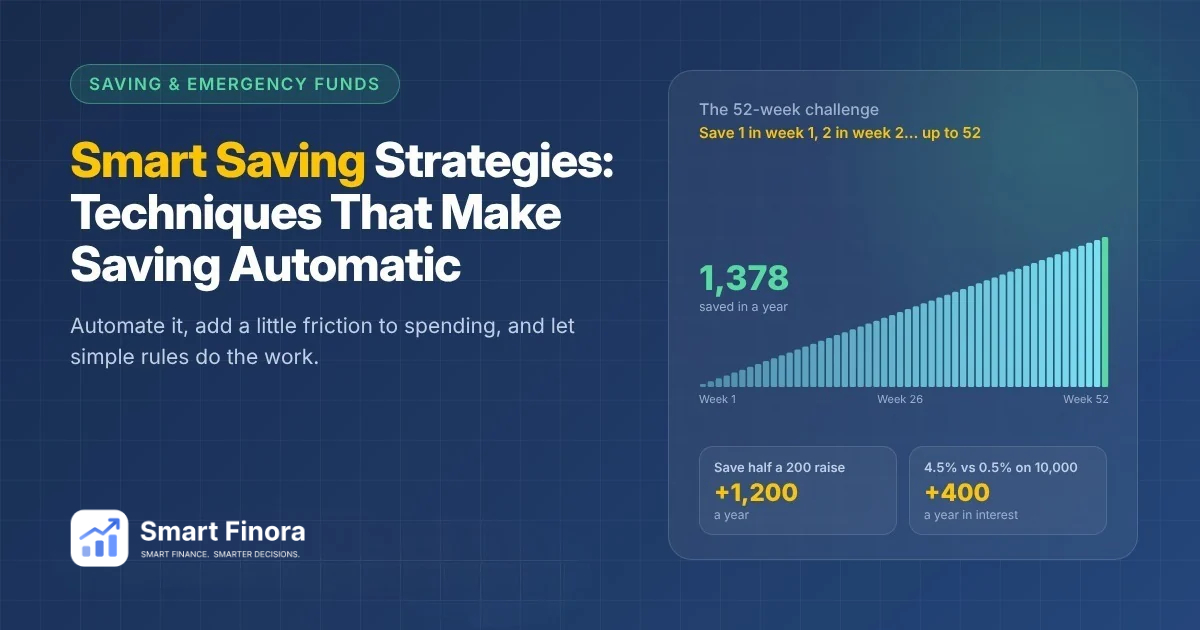
Proven saving techniques — automation, friction, saving pay rises, sinking funds, savings challenges and better rates — and how to combine them.
3 min read