Smart Saving Strategies: Techniques That Make Saving Automatic
Proven saving techniques — automation, friction, saving pay rises, sinking funds, savings challenges and better rates — and how to combine them.
The people who save most reliably rarely rely on willpower. They design their finances so that saving happens by default and spending takes a little effort. These strategies show how, and you only need to pick two or three that suit you.
Make saving the default
- Automatic transfers on payday. Money leaves for savings before you can spend it.
- Split your salary. If your employer allows it, send part of each paycheck directly to a savings account.
- Increase contributions automatically. Some workplace retirement plans let you schedule a 1% increase each year.
Add a little friction to spending
Small obstacles change behaviour. Keep savings at a different bank from your current account, with no card attached. Remove saved card details from shopping sites. Unsubscribe from sales emails. None of this stops you buying what you need — it just gives you a moment to decide.
Save half of every pay rise
You have never lived on a pay rise, so you will not miss part of it. Each time your take-home pay goes up, increase your savings transfer by half of the increase and enjoy the rest.
Example
The pay-rise rule
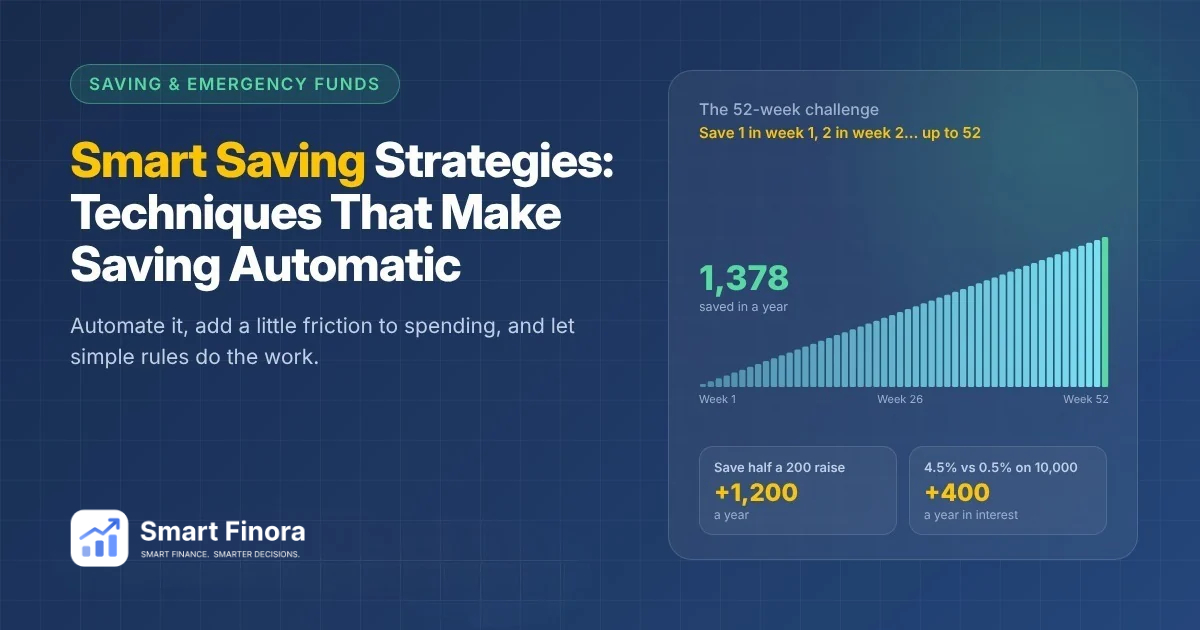
A raise adds 200 a month to take-home pay. Saving half adds 100 a month — 1,200 a year — while your spending still rises by 100 a month. Repeat with every raise and your savings rate climbs without ever feeling like a cut.
Sinking funds and savings challenges
Sinking funds
Divide known future costs — car insurance, holidays, gifts — by the months until they are due, and save that amount monthly in a dedicated pot. When the bill arrives, the money is waiting.
The 52-week challenge
Save 1 in week one, 2 in week two, and so on up to 52 in the last week. The total is 1,378. Many people do it in reverse — 52 first — because the large amounts then fall in January rather than in the expensive weeks before the end-of-year holidays.
Make your savings earn more
Interest rates on savings vary widely, and loyalty is rarely rewarded. On 10,000, the difference between 0.5% and 4.5% is 50 versus 450 a year. Check your rate at least once a year and move money if a safe, protected account pays clearly more.
Compare the effective annual rate (APY or AER) rather than headline rates, and check for withdrawal limits or introductory bonuses that expire.
Get started this week
- Pick one automation: a payday transfer or a salary split.
- Add one bit of friction to the spending that tempts you most.
- Set up one sinking fund for your next big irregular bill.
- Check your savings rate and switch if it is uncompetitive.
Common mistakes
- Locking up emergency money in accounts with long notice periods or penalties.
- Chasing tiny rate differences with constant switching that costs more time than it earns.
- Choosing a challenge that does not fit your budget, then giving up halfway.
- Saving without a goal. Named goals are much easier to stick to.
- Forgetting to raise contributions when income rises.
Related calculators
Frequently asked questions
What is the most effective saving strategy?
Automating a transfer on payday. It removes the monthly decision, which is where most saving plans fail.
Do savings challenges work?
They can, especially for building a first habit or a specific fund. Pick one that suits your budget and pairs with automation.
How often should I compare savings rates?
Once or twice a year is enough for most people, or whenever an introductory rate ends.
Sources and references
- Savings guidance — MoneyHelper (UK Money and Pensions Service)
- Saving and budgeting — Moneysmart (Australian Securities and Investments Commission)
Figures in examples are calculated with Smart Finora’s calculators and rounded. Read how we research and review content in our editorial policy.
Related calculators
Written by
Calculator methodology and tax rules
The Smart Finora Research Desk builds and tests the formulas behind our calculators, maintains the country-specific tax tables, and reviews them whenever official rates change. Each calculator documents its formula, assumptions and the date its rules were last reviewed.