Short-Term vs Long-Term Savings: Where to Keep Money for Each Goal
Why money for next year and money for 20 years from now belong in different places, how to match each goal to its time frame, and the mistakes to avoid.
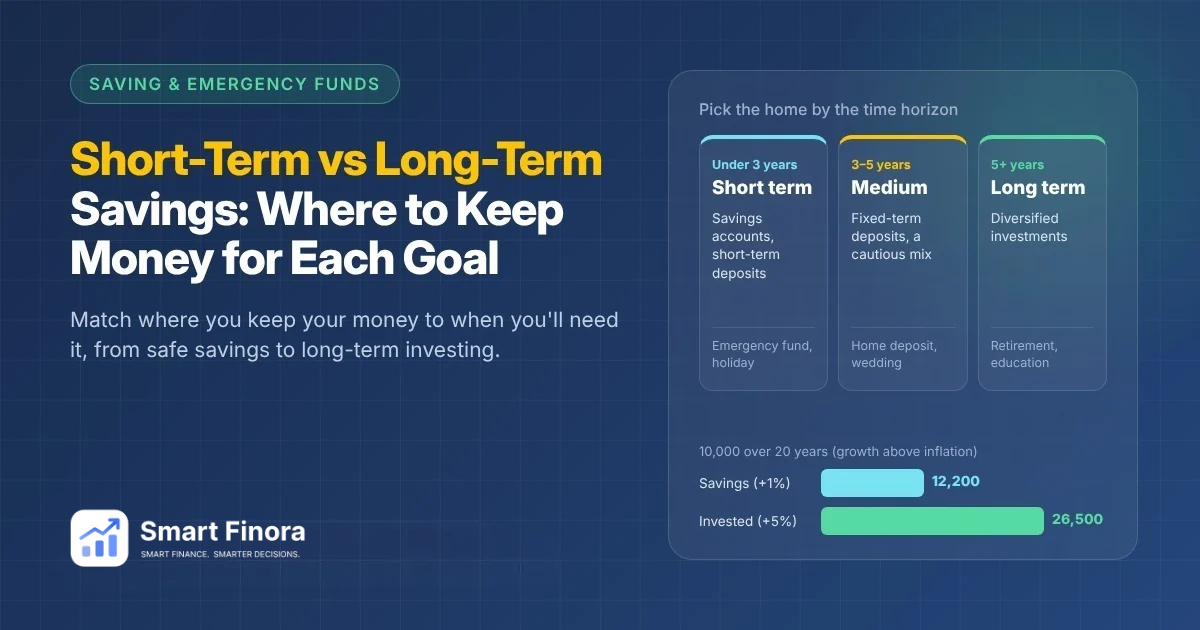
The right place for your money depends less on how much you have than on when you will need it. Money for a holiday next summer and money for retirement in 30 years face completely different risks, so they need different homes.
Sort your goals by time frame
| Time frame | Example goals | Main priority | Typical home |
|---|---|---|---|
| Under 3 years | Emergency fund, holiday, car repair, rent deposit | Safety and access | Savings account, short-term deposit |
| 3–5 years | Home deposit, wedding, car | Mostly safety, some growth | Fixed-term deposits, cautious mix |
| 5 years and more | Retirement, children’s education, financial independence | Growth above inflation | Diversified investments |
Writing each goal down with an amount and a date makes the choice obvious. A goal without a date tends to drift into whatever account is most convenient.
Short-term savings: protect the money
For money you will need soon, the biggest risk is not low interest — it is the value falling just before you need it. Share prices can drop 20–30% in a bad year and take years to recover. That is an acceptable risk over decades, not over months.
Use interest-paying savings accounts or deposits whose maturity date matches your goal. Check that the provider is covered by your country’s deposit protection scheme, and compare rates at least once a year.
Long-term savings: beat inflation
Over long periods, the biggest risk flips: cash that earns less than inflation loses buying power every year. That is why long-term goals usually need investments such as diversified funds.
Example
The cost of playing it too safe
Suppose 10,000 earns 1% a year above inflation in savings, or 5% above inflation in a diversified portfolio. After 20 years, the savings would be worth about 12,200 in today’s money and the investments about 26,500. The investments would have had bad years along the way — which is fine when you do not need the money for two decades.
See how growth compounds with the Compound Interest Calculator, and how prices rise with the Inflation Calculator.
The middle ground and moving money over time
Goals three to five years away sit in between. Many people keep most of that money safe and invest only a small part. For long-term goals, the reverse happens as the date approaches: shift gradually from investments to safer holdings over the final few years so that a market fall right before the goal does not derail it.
Setting up your savings system
- List every goal with its amount and target date.
- Label each one short, medium or long term.
- Open a separate pot or account for each group — or for each goal.
- Automate monthly transfers to each pot.
- Review once a year, and start moving money to safety as long-term goals come within a few years.
Common mistakes
- One pot for everything. Mixing goals makes it impossible to choose the right risk level.
- Investing your emergency fund. It must be there on the worst day, which is often the day markets have fallen.
- Keeping retirement money in cash for decades. It feels safe but quietly loses value to inflation.
- Ignoring fees. A 1.5% annual fee can take a large share of long-term growth.
- Not de-risking near the goal. A home deposit still in shares the month before you buy is a gamble.
Related calculators
Frequently asked questions
Is a fixed deposit short-term or long-term savings?
It suits short- and medium-term goals when the maturity date matches when you need the money. Over very long periods, deposits often struggle to beat inflation after tax.
How long counts as long term?
Usually five years or more. The longer the time frame, the more short-term ups and downs in investments tend to even out.
Should my emergency fund earn interest?
Yes, if you can find a safe, easy-access account paying a reasonable rate. Access and safety come first; interest is a bonus.
Sources and references
- Introduction to saving and investing — Investor.gov (US Securities and Exchange Commission)
- Savings and investment guidance — Moneysmart (Australian Securities and Investments Commission)
Figures in examples are calculated with Smart Finora’s calculators and rounded. Read how we research and review content in our editorial policy.
Related calculators
Written by
Calculator methodology and tax rules
The Smart Finora Research Desk builds and tests the formulas behind our calculators, maintains the country-specific tax tables, and reviews them whenever official rates change. Each calculator documents its formula, assumptions and the date its rules were last reviewed.