What Affects Your Credit Score — and How to Improve It
The main factors behind credit scores, how credit card balances and utilization affect them, and practical steps to build or rebuild your credit over time.
A credit score is a number lenders use to estimate how likely you are to repay borrowed money. It affects whether you are approved for a loan or card, the interest rate you are offered, and sometimes even renting a home. The exact models are proprietary and vary between countries and bureaus, but the main factors are remarkably consistent.
How credit scores work
Your score is calculated from the information in your credit report, which is kept by credit bureaus — for example Equifax, Experian and TransUnion in the US and UK, and CIBIL, Experian, Equifax and CRIF High Mark in India. Lenders report your accounts and payments to these bureaus each month.
Score ranges differ: FICO and VantageScore in the US use 300–850, and CIBIL in India uses 300–900, while UK bureaus each use their own scales. Higher is always better.
The main factors
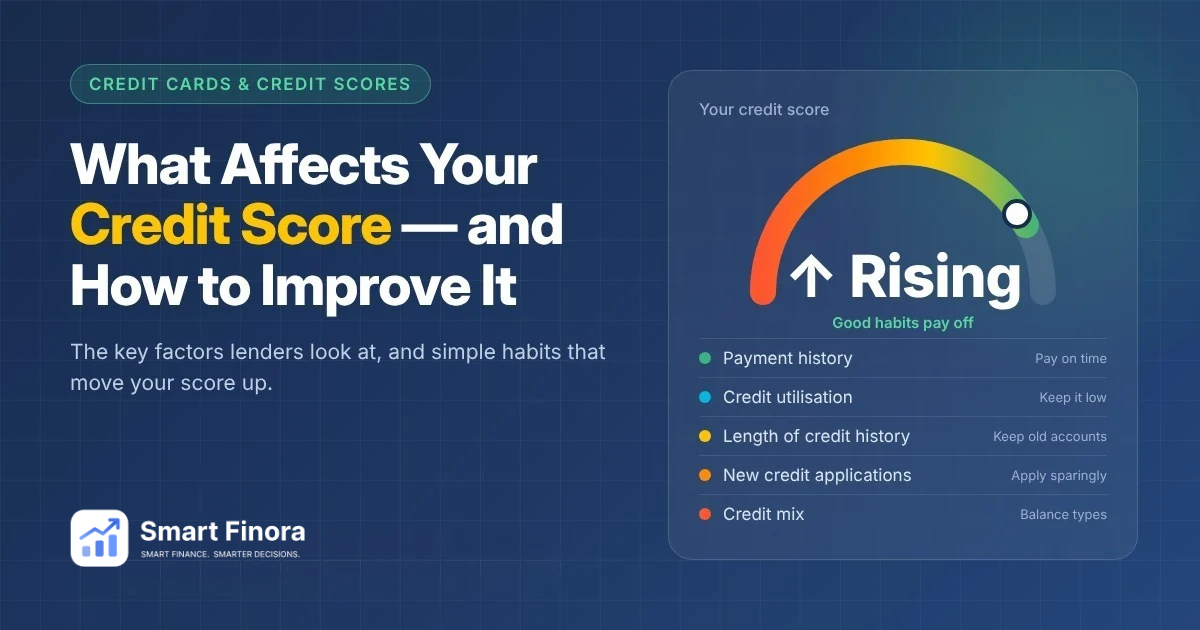
FICO, the most widely used US model, publishes the approximate weight of each factor. Other models differ in detail but look at the same things:
| Factor | Approximate weight (FICO) | What it means |
|---|---|---|
| Payment history | 35% | Whether you pay on time, and any missed payments, defaults or collections |
| Amounts owed | 30% | How much you owe, especially how much of your credit limits you use |
| Length of credit history | 15% | How long your accounts have been open |
| New credit | 10% | Recent applications and newly opened accounts |
| Credit mix | 10% | Experience with different types of credit, such as cards and instalment loans |
Credit utilization: the factor you can change fastest
Credit utilization is the share of your available revolving credit that you are using. If you have cards with a combined limit of 10,000 and balances of 3,000, your utilization is 30%. Lower is better; many lenders and credit educators suggest staying below 30%, and people with the highest scores often use less than 10%.
Because utilization is usually based on the balance reported each month, paying down card balances can improve your score relatively quickly — unlike a missed payment, which can stay on your report for years.
The real cost of carrying a card balance
Example
A 5,000 balance at 22% APR
Paying 150 a month, it takes 52 months to clear and costs about 2,798 in interest. Paying 250 a month clears it in 26 months with about 1,286 of interest — saving roughly 1,512 and halving the time. Lower balances also mean lower utilization, which helps your score along the way.
You can model your own balance with the Loan Payoff Calculator. If you have several debts, paying the highest-rate balance first (the “avalanche” method) saves the most interest.
How to improve your credit score
- Pay every bill on time. Set up automatic minimum payments as a safety net, then pay more manually.
- Reduce your utilization. Pay balances down, and consider paying before the statement date so a lower balance is reported.
- Keep old accounts open if they have no annual fee — they lengthen your history and add to your available credit.
- Apply for new credit sparingly. Each application can cause a small, temporary dip; several in a short time can add up.
- Check your credit reports at least once a year and dispute any errors with the bureau.
- Be patient. Negative items fade over time as positive history builds up.
Related calculators
Frequently asked questions
Does checking my own credit score lower it?
No. Checking your own score or report is a soft inquiry and does not affect your score. Hard inquiries happen when a lender checks your credit after you apply.
How long do late payments stay on my report?
In the US, most late payments can remain for up to seven years, and in the UK for six years, although their impact fades over time.
Do I need a credit card to build credit?
Not necessarily. Instalment loans and, in some countries, rent or utility reporting can build history. A card used lightly and paid in full each month is one of the simplest ways, though.
Sources and references
- What’s in my FICO Scores? — myFICO
- Credit reports and scores — Consumer Financial Protection Bureau
- Free credit reports — AnnualCreditReport.com
Figures in examples are calculated with Smart Finora’s calculators and rounded. Read how we research and review content in our editorial policy.
Related calculators
Written by
Personal finance writers and editors
The Smart Finora Editorial Team writes and maintains our finance guides. Every guide is researched from primary sources such as government agencies, central banks and regulators, checked against our calculators, and reviewed before publication under our editorial policy.