APR vs. APY: Understanding the Real Cost and Return of Interest
APR and APY look similar but measure different things. Learn how each is calculated, why compounding matters, and which number to compare for loans and savings.
Banks and lenders quote interest rates in several ways, and the differences are not just jargon. Two accounts advertising “5%” can pay different amounts, and two loans at the same rate can cost different amounts. Knowing what APR and APY measure helps you compare like with like.
What APR means
APR (annual percentage rate) is the yearly cost of borrowing. For loans, it combines the interest rate with certain mandatory fees — such as origination or processing charges — expressed as a yearly percentage. In many countries, lenders are required by law to disclose it so borrowers can compare offers.
Crucially, APR is usually a nominal rate: it does not include the effect of compounding within the year. A credit card with a 24% APR charges 2% a month, but because interest is added to the balance, a balance left unpaid for a whole year grows by more than 24%.
What APY means
APY (annual percentage yield) is the yearly return on savings including compounding. In the UK the equivalent figure is the AER (annual equivalent rate). It answers a simple question: if I leave my money for one year, by what percentage will it grow?
The conversion is: APY = (1 + r/n)ⁿ − 1, where r is the nominal annual rate and n is the number of compounding periods per year.
The difference in numbers
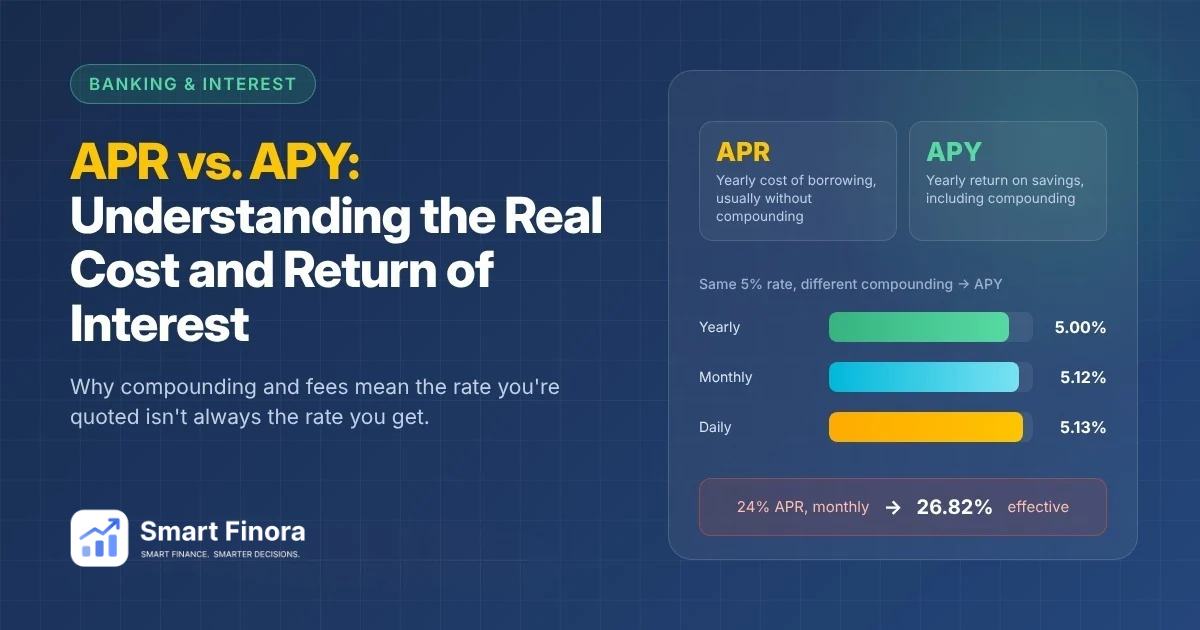
| Nominal rate | Compounding | Effective annual rate |
|---|---|---|
| 5% | Yearly | 5.00% |
| 5% | Monthly | 5.12% |
| 5% | Daily | 5.13% |
| 12% | Monthly | 12.68% |
| 24% | Monthly | 26.82% |
On savings, the gap between nominal and effective rates is modest. On high-interest debt it becomes significant: a 24% APR compounded monthly is effectively 26.82% a year.
Example
When fees raise the APR
A 10,000 personal loan at 12% for 3 years has a monthly payment of about 332. If the lender deducts a 3% origination fee, you receive only 9,700 but repay the same amount. Solving for the rate that matches 9,700 received against those payments gives an effective APR of about 14.1%. The Personal Loan Calculator does this calculation for you.
Which number should you compare?
- For savings and deposits: compare APY (or AER). It already accounts for compounding, so a higher APY always means more interest.
- For loans: compare APR. It captures fees that a bare interest rate hides.
- For credit cards: remember that the APR understates the true yearly cost if you carry a balance, because of monthly compounding.
Where simple interest still appears
Some products use simple interest, where interest is calculated only on the original principal: I = P × r × t. You will see it on some short-term loans, bonds and treasury bills. For the same rate and period, simple interest earns (or costs) less than compound interest. The Simple Interest Calculator shows the difference.
Related calculators
Frequently asked questions
Is APY always higher than APR?
For the same nominal rate, the effective yield is equal to or higher than the nominal rate, because compounding adds interest on interest. They are equal only with yearly compounding.
What is the difference between APR and interest rate?
The interest rate is the cost of borrowing the principal. APR adds certain fees, so it is usually higher and gives a fuller picture of the loan’s cost.
Why do savings accounts advertise APY but loans advertise APR?
Each figure is the one required by disclosure rules for that product, and — cynically — the one that looks more attractive: APY makes savings returns look higher, and APR makes loan costs look lower than the effective rate.
Sources and references
- Ask CFPB: answers about credit cards, loans and APR — Consumer Financial Protection Bureau
- Savings and interest rates explained — MoneyHelper (UK Money and Pensions Service)
Figures in examples are calculated with Smart Finora’s calculators and rounded. Read how we research and review content in our editorial policy.
Related calculators
Written by
Calculator methodology and tax rules
The Smart Finora Research Desk builds and tests the formulas behind our calculators, maintains the country-specific tax tables, and reviews them whenever official rates change. Each calculator documents its formula, assumptions and the date its rules were last reviewed.