Understanding Inflation and Its Effect on Your Savings
What inflation is, how it quietly erodes the value of cash, the difference between nominal and real returns, and practical ways to protect your savings.
Inflation is the gradual rise in prices across an economy. A few percent a year doesn’t sound like much, but compounded over a decade or two it changes what your money can buy dramatically. Understanding inflation is essential for setting savings goals, judging investment returns and planning for retirement.
What inflation is and how it is measured
Inflation is usually measured with a consumer price index (CPI), which tracks the cost of a typical basket of goods and services over time. National statistics agencies publish it monthly — for example the US Bureau of Labor Statistics, the UK Office for National Statistics and India’s Ministry of Statistics.
Many central banks aim to keep inflation around 2% a year, believing that low, stable inflation supports a healthy economy. In practice, inflation can run well above target for extended periods, as many countries experienced in 2021–2023.
How inflation erodes purchasing power
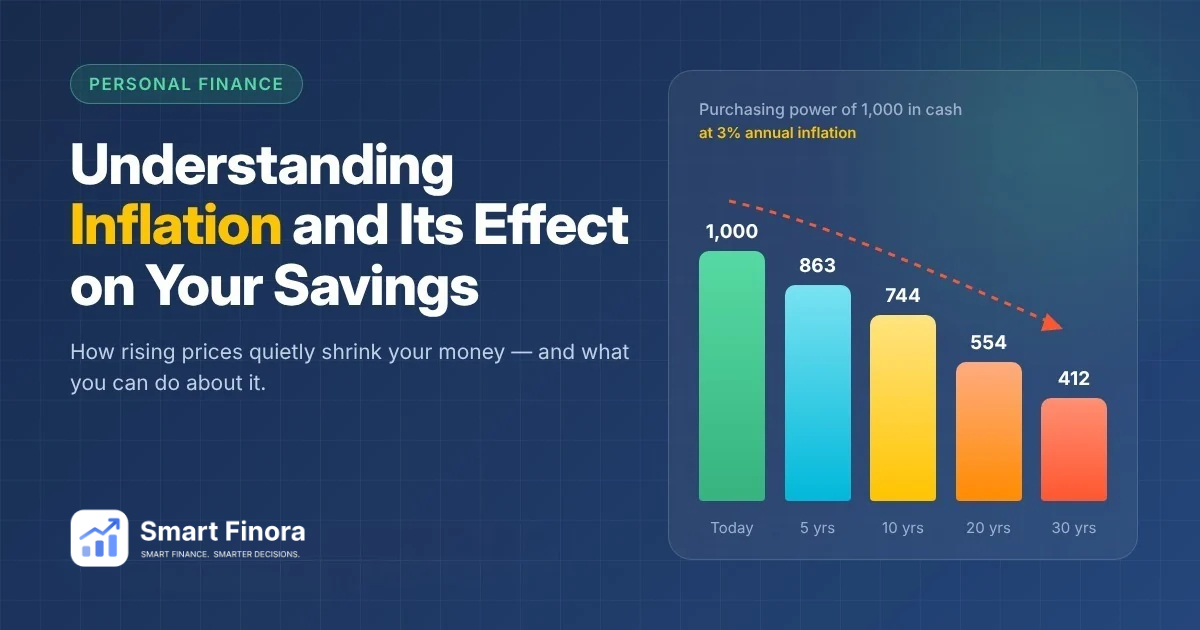
Inflation compounds just like interest. At 3% a year, prices rise about 34% over 10 years and about 81% over 20 years. Put the other way, money kept in cash for 20 years at 3% inflation buys only about 55% of what it once did.
| Years | Cost of something worth 1,000 today (3% inflation) | Purchasing power of 1,000 held in cash |
|---|---|---|
| 5 | 1,159 | 863 |
| 10 | 1,344 | 744 |
| 20 | 1,806 | 554 |
| 30 | 2,427 | 412 |
Use the Inflation Calculator to see the effect at other rates and time periods.
Nominal vs. real returns
The interest rate your bank quotes is the nominal return. The real return is what is left after inflation, and it is what actually changes your standard of living. The exact formula is: real return = (1 + nominal) ÷ (1 + inflation) − 1.
Example
A savings account paying 4.5% with 3% inflation
The real return is 1.045 ÷ 1.03 − 1 ≈ 1.46%. Your balance grows by 4.5%, but its buying power grows by only about 1.5%. If tax is charged on the interest, the real after-tax return is lower still — and if inflation is higher than your interest rate, your savings are losing value in real terms even as the balance rises.
Planning with inflation in mind
- Long-term goals: set targets in future money. University fees or a home deposit in 15 years will likely cost much more than today.
- Retirement: a fixed income loses value every year. Plan for withdrawals that rise with inflation — the Retirement Income Calculator does this by default.
- Salary: a raise below the inflation rate is a real-terms pay cut. Compare raises with the latest CPI figure.
- Debt: inflation reduces the real burden of fixed-rate debt over time, which is one reason long fixed-rate mortgages can work in borrowers’ favour.
Ways to protect your savings
- Keep cash for short-term needs only. An emergency fund and money for goals within a few years belong in cash, but in the best-paying safe account you can find.
- Invest for the long term. Diversified investments such as equity funds have historically outpaced inflation over long periods, though with ups and downs along the way.
- Consider inflation-linked bonds. Some governments issue bonds whose value rises with inflation, such as US TIPS and UK index-linked gilts.
- Review fixed-income products. A long fixed deposit is attractive when rates are high, but less so if inflation rises above its rate.
Related calculators
Frequently asked questions
Why does my personal inflation feel higher than the official rate?
CPI reflects an average basket. If you spend more than average on items whose prices are rising fastest — such as rent, food or energy — your personal inflation rate can be higher.
Is deflation good for savers?
Falling prices increase the real value of cash, but widespread deflation is usually a sign of a weak economy, which can bring job losses and falling asset prices.
What inflation rate should I use for long-term planning?
Many planners use 2.5–3.5% for developed economies, and higher figures for countries with a history of higher inflation. Testing more than one rate is the safest approach.
Sources and references
- Consumer Price Index — U.S. Bureau of Labor Statistics
- Inflation and price indices — Office for National Statistics (UK)
- Treasury Inflation-Protected Securities (TIPS) — TreasuryDirect
Figures in examples are calculated with Smart Finora’s calculators and rounded. Read how we research and review content in our editorial policy.
Related calculators
Written by
Personal finance writers and editors
The Smart Finora Editorial Team writes and maintains our finance guides. Every guide is researched from primary sources such as government agencies, central banks and regulators, checked against our calculators, and reviewed before publication under our editorial policy.