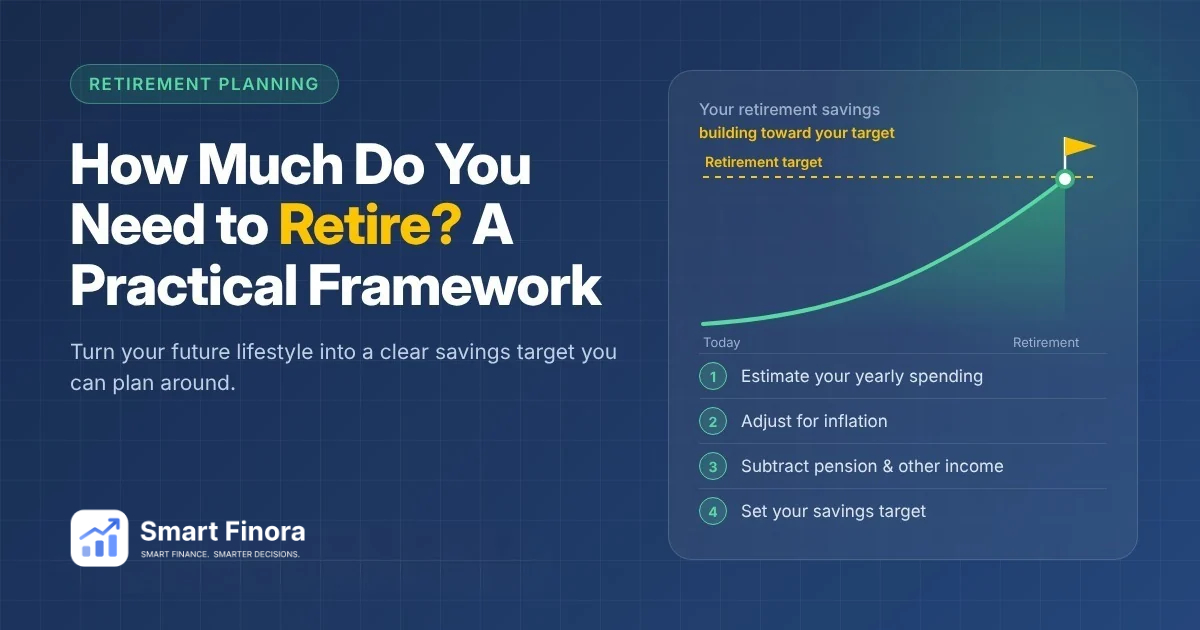
Retirement Planning
How Much Do You Need to Retire? A Practical Framework
A step-by-step way to estimate your retirement number: target income, pensions, the 4% rule, inflation and what to do if your projection falls short.
3 min read
How much will you have when you retire, and is it enough? Enter your age, savings and contributions, along with your assumptions for returns and inflation. The calculator projects your pot and compares it with the amount needed to fund your target income.
$1,048,975
On these assumptions there is a shortfall. Saving more, retiring later or adjusting your target income would close the gap.
Swipe the table sideways to see every column.
| Age | Total contributed | Growth | Balance |
|---|---|---|---|
| 36 | $57,200 | $3,285 | $60,485 |
| 37 | $64,544 | $7,221 | $71,765 |
| 38 | $72,035 | $11,857 | $83,892 |
| 39 | $79,676 | $17,245 | $96,920 |
| 40 | $87,469 | $23,441 | $110,910 |
| 41 | $95,418 | $30,504 | $125,922 |
| 42 | $103,527 | $38,497 | $142,024 |
| 43 | $111,797 | $47,488 | $159,285 |
| 44 | $120,233 | $57,548 | $177,782 |
| 45 | $128,838 | $68,754 | $197,592 |
Needed = Target income × (1 + inflation)^years ÷ withdrawal rate
The projection grows your savings month by month. Your target income is inflated to retirement so it keeps the same buying power, and dividing it by the withdrawal rate gives the pot needed. For example, $40,000 a year at a 4% withdrawal rate needs a pot 25 times larger: $1,000,000 in today’s money.
A 30-year-old with $20,000 saved, investing $500 a month at 6% for 35 years, could have about $874,826 at 65 — roughly $368,626 in today’s money. Funding $40,000 a year (in today’s money) at a 4% withdrawal rate would need $2,373,205.
It depends on your spending. A common starting point is 70–80% of pre-retirement income, minus any guaranteed pensions. Our retirement guide walks through a practical framework.
It suggests withdrawing 4% of your savings in the first year of retirement and adjusting for inflation thereafter. It comes from historical US market studies and is a guideline, not a guarantee.
Long-term planning often uses a real (after-inflation) return of a few percent for a balanced portfolio. Test cautious and optimistic scenarios — small changes in assumptions make large differences over decades.
Retirement Planning
A step-by-step way to estimate your retirement number: target income, pensions, the 4% rule, inflation and what to do if your projection falls short.
3 min read
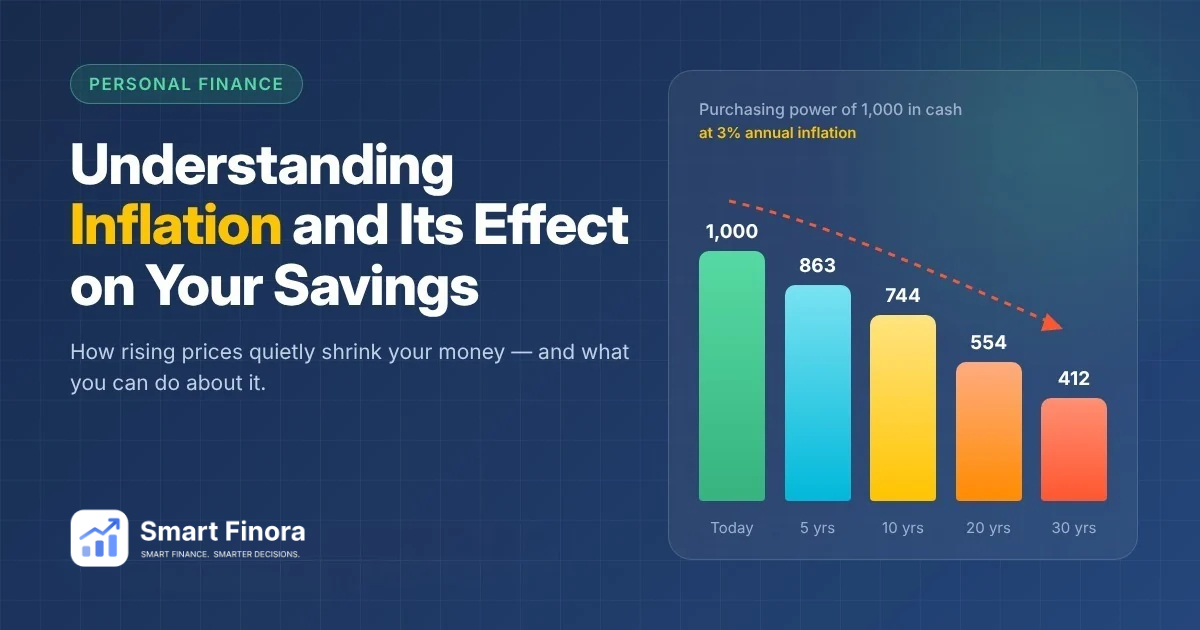
Personal Finance
What inflation is, how it quietly erodes the value of cash, the difference between nominal and real returns, and practical ways to protect your savings.
3 min read
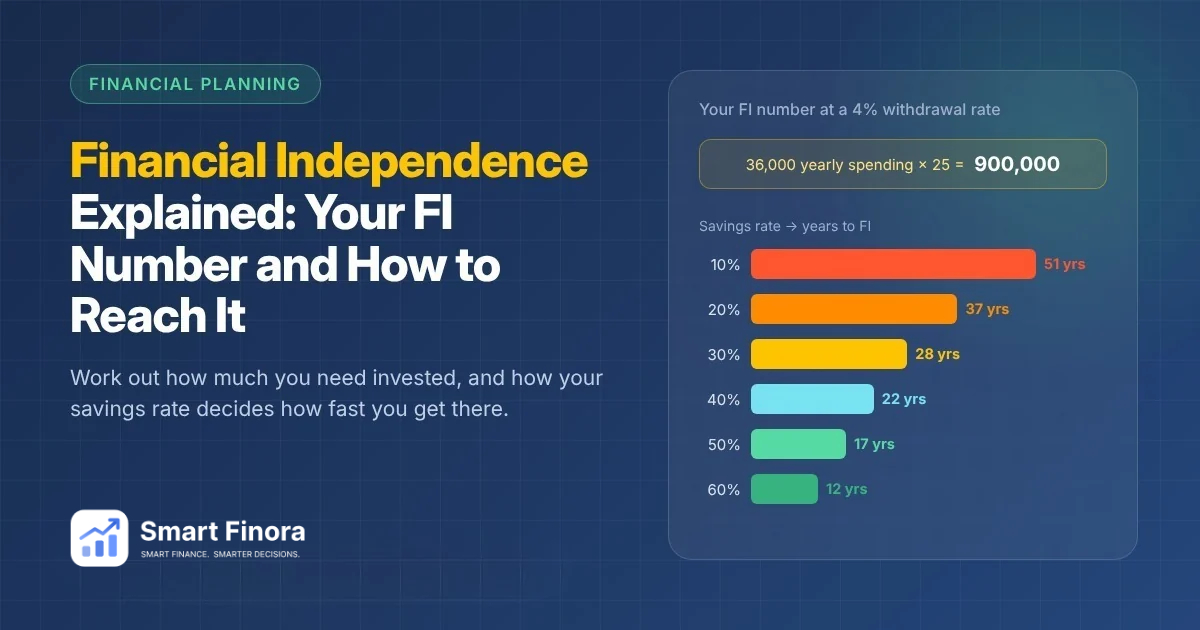
Financial Planning
What financial independence means, how to calculate your FI number with the 4% rule, why your savings rate matters most, and the risks to plan for.
3 min read