Financial Independence Explained: Your FI Number and How to Reach It
What financial independence means, how to calculate your FI number with the 4% rule, why your savings rate matters most, and the risks to plan for.
Financial independence means having enough invested that your living costs can be paid from your investments rather than a paycheck. Some people use it to retire early; many more use it as freedom — to work less, change careers or take time off without fear. The maths behind it is surprisingly simple.
Your FI number
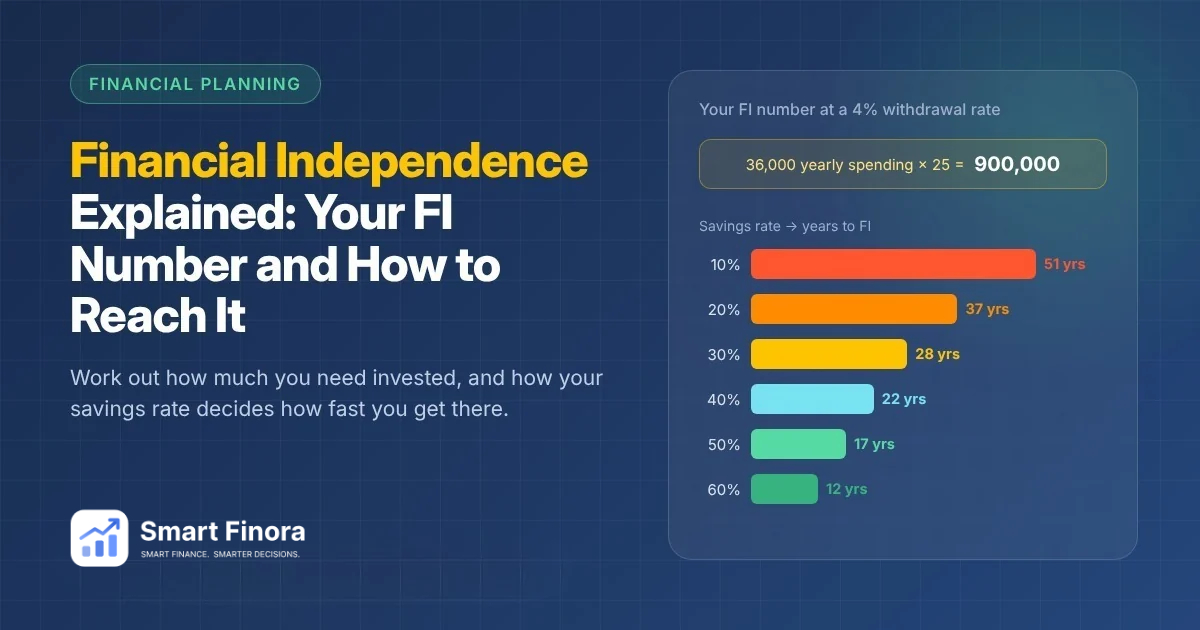
Your FI number is the amount you need invested to cover a year of spending indefinitely. It is calculated as: FI number = yearly spending ÷ withdrawal rate.
With the common 4% withdrawal rate, that means 25 times your yearly spending.
Example
Working out an FI number
A household spends 36,000 a year, including irregular costs. At a 4% withdrawal rate their FI number is 36,000 ÷ 0.04 = 900,000. Using a more cautious 3.5% raises it to about 1,028,600. Cutting yearly spending by 3,000 would lower the 4% target by 75,000 — every unit of spending you remove reduces the target 25 times over.
Why your savings rate matters most
Your savings rate does two jobs at once: it sets how much you invest, and it reveals how little you need to live on. Raising it shortens the path dramatically.
| Savings rate | Years to financial independence |
|---|---|
| 10% | 51 |
| 20% | 37 |
| 30% | 28 |
| 40% | 22 |
| 50% | 17 |
| 60% | 12 |
These estimates assume you start from zero, earn 5% a year above inflation and stop at 25 times your spending. The exact figures change with your assumptions, but the pattern holds: going from 10% to 20% saves about 15 years. Find your own rate with the Savings Rate Calculator.
Different versions of financial independence
- Lean FI: covering a modest, minimal budget.
- Comfortable or “fat” FI: covering a generous lifestyle with room for travel and extras.
- Coast FI: having enough invested that it will grow to your FI number by a normal retirement age without new contributions — so you only need to earn your current spending.
- Part-time or “barista” FI: investments cover part of your costs, and part-time work covers the rest.
Risks to plan for
- Sequence of returns: a market crash early in retirement does more damage than one later.
- Healthcare: in countries without universal public healthcare, costs before state cover begins can be large.
- Inflation: rising prices can erode a fixed budget; plan in today’s money and keep some growth assets.
- Rules and pensions: access ages for retirement accounts and state pensions differ by country and can change.
A margin of safety — a lower withdrawal rate, a cash buffer, or flexibility to earn a little or spend less in bad years — makes a plan much more resilient.
How to work towards financial independence
- Calculate your current yearly spending accurately, including irregular costs.
- Work out your FI number with a cautious withdrawal rate.
- Raise your savings rate step by step, especially with pay rises.
- Invest in low-cost, diversified funds and use tax-advantaged accounts available in your country.
- Track progress yearly with the Financial Independence Calculator and adjust.
Common mistakes
- Underestimating spending, especially irregular and future costs such as healthcare or home repairs.
- Relying on optimistic returns. High assumed returns make the target look closer than it is.
- Cutting so hard you burn out. A plan you can sustain for years beats an extreme one you abandon.
- Ignoring taxes on withdrawals, which depend on the account and the country.
- Treating the number as a finish line. Your spending, goals and circumstances will change.
Related calculators
Frequently asked questions
Is FIRE the same as financial independence?
FIRE stands for Financial Independence, Retire Early. Financial independence is the goal; retiring early is one way people choose to use it.
Should I include my home in my FI number?
No — your FI number is about invested assets that produce income. Owning your home outright does lower your yearly spending, which lowers the number.
How do state pensions affect financial independence?
Expected pension income reduces how much your portfolio needs to cover once it starts. Before that, investments need to cover all spending.
Sources and references
- Introduction to investing and retirement planning — Investor.gov (US Securities and Exchange Commission)
- Retirement and pension guidance — MoneyHelper (UK Money and Pensions Service)
Figures in examples are calculated with Smart Finora’s calculators and rounded. Read how we research and review content in our editorial policy.
Related calculators
Written by
Calculator methodology and tax rules
The Smart Finora Research Desk builds and tests the formulas behind our calculators, maintains the country-specific tax tables, and reviews them whenever official rates change. Each calculator documents its formula, assumptions and the date its rules were last reviewed.