Personal Financial Planning: A Step-by-Step Framework
A practical six-step framework for personal financial planning: know where you stand, protect yourself, clear expensive debt, set goals, invest and review.
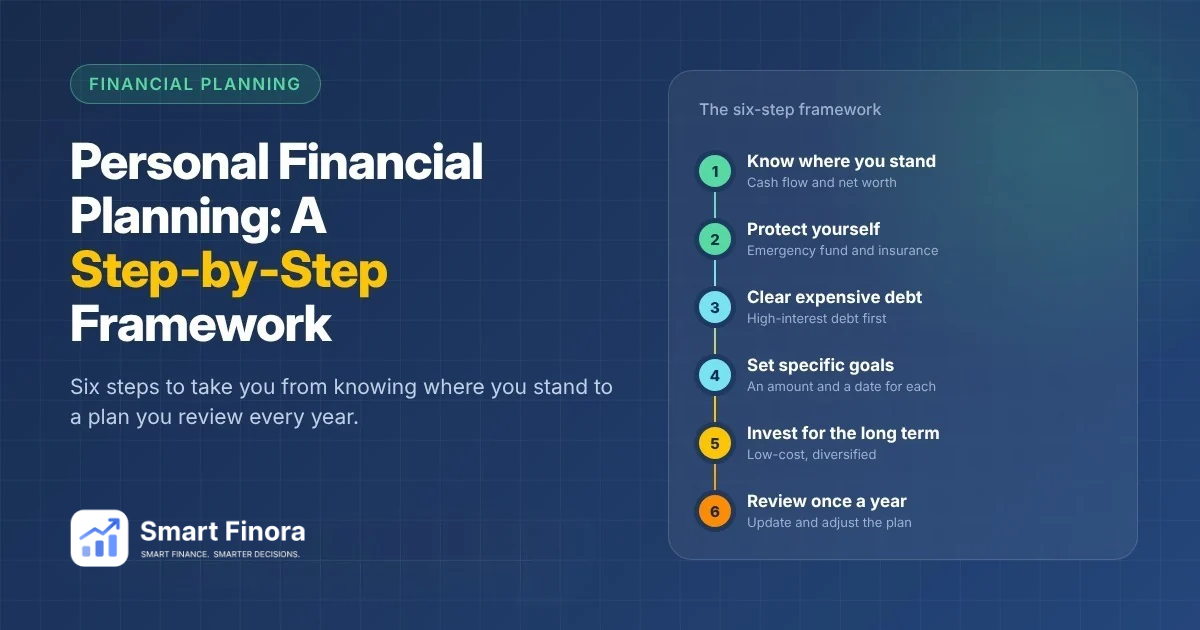
A financial plan does not need to be a thick document from an adviser. At its simplest, it is a short list of decisions: how much you spend and save, how you are protected, what you are working towards and in what order. This framework walks through the six steps that matter in almost every country and at almost every income.
Step 1: Know where you stand
Two numbers describe your starting point. Cash flow — income minus spending each month — shows whether you are moving forward. Net worth — what you own minus what you owe — shows where you are today.
Work out both: the Monthly Expense Calculator captures your real spending, including yearly bills, and the Net Worth Calculator adds up your balance sheet.
Step 2: Protect yourself
Protection comes before growth, because one bad event can undo years of saving. Build an emergency fund — three to six months of essential costs is a common target — and check that you have the insurance your situation needs: health cover where there is no public system, income protection, and life insurance if others depend on you.
Example
Sizing a safety net
Essential costs — rent, bills, food, transport, insurance and minimum debt payments — come to 2,200 a month. With a fairly secure job and no dependants, four months of cover means an emergency fund target of 8,800. Saving 400 a month reaches it in 22 months; a starter fund of one month’s costs, 2,200, is in place after about six.
Step 3: Clear expensive debt
Paying off a card charging 20% or more is a guaranteed return no investment can promise. Make a plan for high-interest debt before investing beyond any employer retirement match. Lower-rate debt such as a mortgage can usually be repaid on schedule while you save and invest.
Step 4: Set specific goals
Turn wishes into goals with an amount and a date, then split them by time frame: short term (under three years), medium term (three to five) and long term (more than five). Each time frame needs a different savings approach.
| Goal | Amount | Target date | Monthly saving | Where it is kept |
|---|---|---|---|---|
| Emergency fund | 9,000 | 18 months | 500 | Easy-access savings |
| Car replacement | 6,000 | 4 years | 125 | Fixed-term deposit |
| Retirement | Long term | Age 65 | 10% of pay | Workplace plan and index funds |
This is what a one-page plan can look like. It does not need to be more complicated to be useful.
Step 5: Invest for the long term
For goals more than five years away, low-cost diversified investments have historically beaten cash and inflation, despite falls along the way. Use any tax-advantaged retirement or savings accounts available where you live, keep fees low, and automate monthly contributions.
Step 6: Review once a year
- Recalculate your net worth and compare it with last year.
- Check your savings rate and raise it if income has grown.
- Review insurance cover, beneficiaries and your will.
- Update goals that have changed or been reached.
- Rebalance investments if they have drifted from your plan.
Common mistakes
- A plan without numbers. “Save more” is a wish; “500 a month into the emergency fund” is a plan.
- Skipping protection. Investing before you have an emergency fund or needed insurance leaves you exposed.
- Copying someone else’s plan. Your income, country, family and goals are different.
- Setting and forgetting. Life changes; a plan that is never reviewed drifts out of date.
- Ignoring local rules. Tax-advantaged accounts and pension rules vary by country and can make a big difference.
Related calculators
Frequently asked questions
At what age should I start financial planning?
With your first regular income. Starting early gives compounding more time, and early habits are easier to build than later corrections.
How long does it take to create a financial plan?
A first version can be done in an afternoon: calculate net worth and cash flow, list goals and set up automatic savings. Refine it over the following months.
What is the most important part of a plan?
Spending less than you earn, consistently. Every other step depends on having money left over each month.
Sources and references
- Planning and saving guidance — MoneyHelper (UK Money and Pensions Service)
- Introduction to saving and investing — Investor.gov (US Securities and Exchange Commission)
- Investor education — Securities and Exchange Board of India
Figures in examples are calculated with Smart Finora’s calculators and rounded. Read how we research and review content in our editorial policy.
Related calculators
Written by
Personal finance writers and editors
The Smart Finora Editorial Team writes and maintains our finance guides. Every guide is researched from primary sources such as government agencies, central banks and regulators, checked against our calculators, and reviewed before publication under our editorial policy.