Retirement Planning
How Much Do You Need to Retire? A Practical Framework
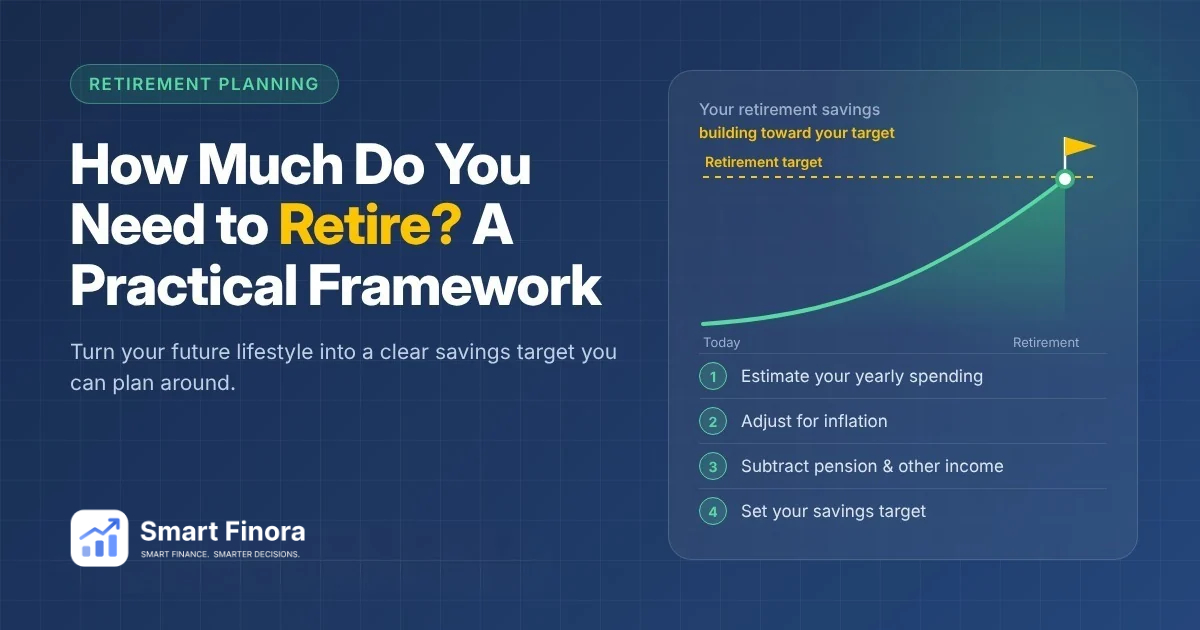
A step-by-step way to estimate your retirement number: target income, pensions, the 4% rule, inflation and what to do if your projection falls short.
3 min read
Once you retire, the question becomes how much you can spend each month without running out. Enter your savings, expected return and how many years the money must last. Turn on inflation adjustment to keep your income’s buying power steady.
$3,012.18
Swipe the table sideways to see every column.
| Year | Monthly income | Withdrawn this year | Balance at year end |
|---|---|---|---|
| 1 | $3,012.18 | $36,146 | $751,385 |
| 2 | $3,087.48 | $37,050 | $751,917 |
| 3 | $3,164.67 | $37,976 | $751,528 |
| 4 | $3,243.78 | $38,925 | $750,148 |
| 5 | $3,324.88 | $39,899 | $747,701 |
| 6 | $3,408.00 | $40,896 | $744,108 |
| 7 | $3,493.20 | $41,918 | $739,286 |
| 8 | $3,580.53 | $42,966 | $733,144 |
| 9 | $3,670.04 | $44,041 | $725,589 |
| 10 | $3,761.79 | $45,142 | $716,521 |
Savings = Σ PMT × (1 + g)ʸ × (1 + i)^(−12y) × [1 − (1 + i)^(−12)] ÷ i
This is the present value of a growing stream of monthly withdrawals that exhausts the savings exactly at the end of the period. Without inflation adjustment it reduces to the standard annuity formula PMT = Savings × i ÷ [1 − (1 + i)⁻ⁿ].
$500,000 earning 5% a year can pay about $2,922.95 a month for 25 years before running out, a total of $876,885.
Many planners use age 90–95 or later, since outliving your money is a bigger risk than leaving some behind.
Usually yes. Prices tend to rise over a long retirement, and a fixed income steadily buys less.
Long-term planning often uses a real (after-inflation) return of a few percent for a balanced portfolio. Test cautious and optimistic scenarios — small changes in assumptions make large differences over decades.
Retirement Planning
A step-by-step way to estimate your retirement number: target income, pensions, the 4% rule, inflation and what to do if your projection falls short.
3 min read