Compound Interest Explained with Real Examples
What compound interest is, how the formula works, why time matters more than the amount you start with, and how compounding works against you on debt.
Compound interest is interest earned on interest. It sounds like a small technical detail, but over long periods it is the single biggest force in personal finance — building wealth for savers and investors, and building debt for borrowers who carry high-interest balances. Here is how it works, with numbers you can check yourself.
Simple vs. compound interest
With simple interest, you earn interest only on your original deposit. 10,000 at 7% simple interest earns 700 every year, so after 10 years you have 17,000.
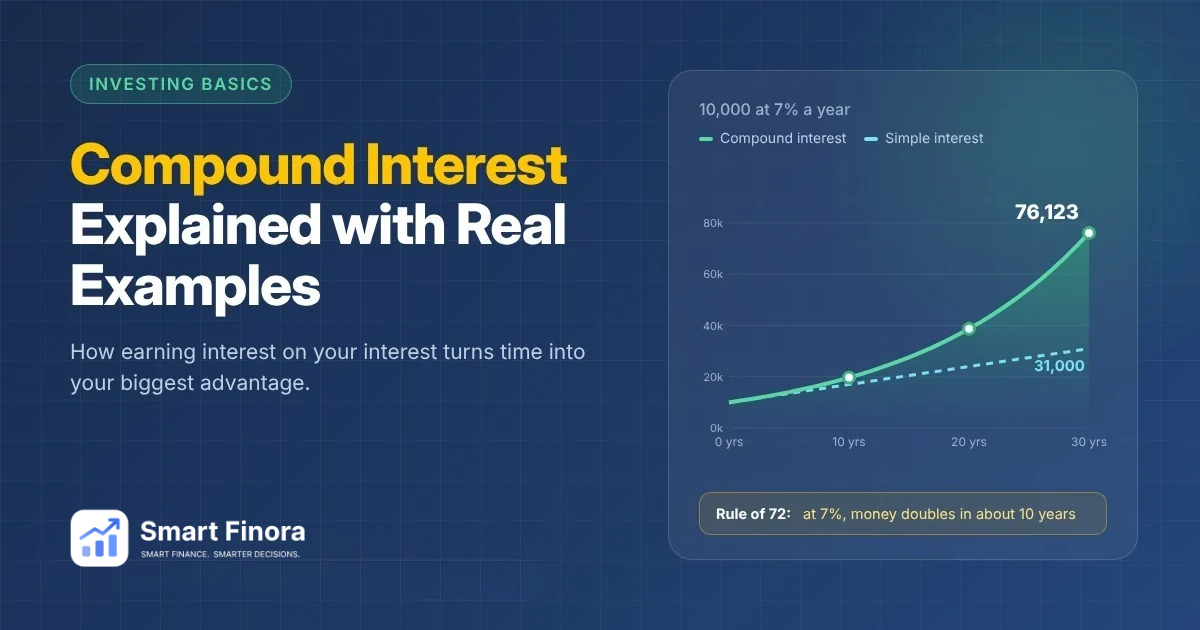
With compound interest, each year’s interest is added to the balance and earns interest itself. In year one you earn 700; in year two you earn 7% of 10,700, which is 749; and so on. After 10 years of annual compounding the balance is 19,671.51 — about 2,672 more than simple interest, without adding a single extra deposit.
The compound interest formula
The standard formula is A = P × (1 + r/n)^(n·t), where A is the final amount, P the starting principal, r the annual rate as a decimal, n the number of times interest compounds per year, and t the number of years.
Plugging in our example with annual compounding: 10,000 × (1.07)¹⁰ = 19,671.51. The Compound Interest Calculator handles monthly or daily compounding and regular contributions as well.
Time is the key ingredient
Compounding is slow at first and dramatic later. Look at what the same 10,000 does at 7% a year as time goes on:
| Years invested | Balance | Growth from interest |
|---|---|---|
| 10 | 19,672 | 9,672 |
| 20 | 38,697 | 28,697 |
| 30 | 76,123 | 66,123 |
The balance roughly doubles every decade, which means the third decade adds more than the first two combined. That is why starting early matters so much.
Example
Starting 10 years earlier
Investing 200 a month at 7% (compounded monthly) for 40 years grows to about 525,000. Starting ten years later and investing for 30 years produces about 244,000. The early starter contributes only 24,000 more in total but ends up with more than twice as much.
A shortcut: the Rule of 72
To estimate how long it takes money to double, divide 72 by the annual rate. At 7%, money doubles in about 72 ÷ 7 ≈ 10.3 years — consistent with the table above. At 4%, it takes about 18 years; at 12%, about 6 years.
The rule works in reverse for costs too. At 3% inflation, prices double in about 24 years.
Does compounding frequency matter?
More frequent compounding gives a slightly higher effective return. A 5% rate compounded annually yields exactly 5% a year; compounded monthly it yields about 5.12%; compounded daily, about 5.13%. The effect is real but small. The rate and the time you stay invested matter far more.
This is also why banks advertise the APY (annual percentage yield) on savings, which includes compounding. Our guide to APR vs. APY explains the difference.
When compounding works against you
Credit cards and some loans compound interest on unpaid balances. At a typical card rate of over 20% a year, an unpaid balance can roughly double in under four years if nothing is repaid. Paying only the minimum keeps you in debt for years while interest compounds.
Related calculators
Frequently asked questions
Is compound interest guaranteed on investments?
Interest on savings accounts and fixed deposits is contractual. Investment returns such as stocks and funds are not guaranteed — they compound over time on average, but values can fall in any given year.
How often do savings accounts compound?
Many compound daily or monthly and pay interest monthly, but terms vary. Compare accounts using the APY or AER, which already includes compounding.
What is continuous compounding?
It is the mathematical limit of compounding infinitely often: A = P × e^(rt). In practice it gives almost the same result as daily compounding.
Sources and references
- Compound interest calculator and explanation — Investor.gov (U.S. Securities and Exchange Commission)
- Introduction to investing — Investor.gov (U.S. Securities and Exchange Commission)
Figures in examples are calculated with Smart Finora’s calculators and rounded. Read how we research and review content in our editorial policy.
Related calculators
Written by
Calculator methodology and tax rules
The Smart Finora Research Desk builds and tests the formulas behind our calculators, maintains the country-specific tax tables, and reviews them whenever official rates change. Each calculator documents its formula, assumptions and the date its rules were last reviewed.