SIP vs. Lump Sum Investing: What the Numbers Say
Compare investing a lump sum with investing monthly through a SIP. See how each performs in rising and volatile markets and how to choose for your situation.
If you have money to invest, should you put it all in at once or spread it out with regular monthly investments? The honest answer is that each approach wins in different conditions. Looking at the mathematics — and at human behaviour — makes the choice much clearer.
Two ways to invest
A lump sum means investing a large amount in one go — for example, a bonus, an inheritance or the proceeds of a sale.
A SIP (Systematic Investment Plan) means investing a fixed amount at regular intervals, usually monthly. Outside India the same idea is often called dollar-cost averaging or a regular investment plan. For most people with a salary, a SIP is not a choice between strategies at all: it is simply how they invest, a little from each pay cheque.
Why lump sums often come out ahead
Markets have historically risen more often than they have fallen. Money invested earlier spends more time compounding, so when you already have the cash, a lump sum has the advantage on average.
Example
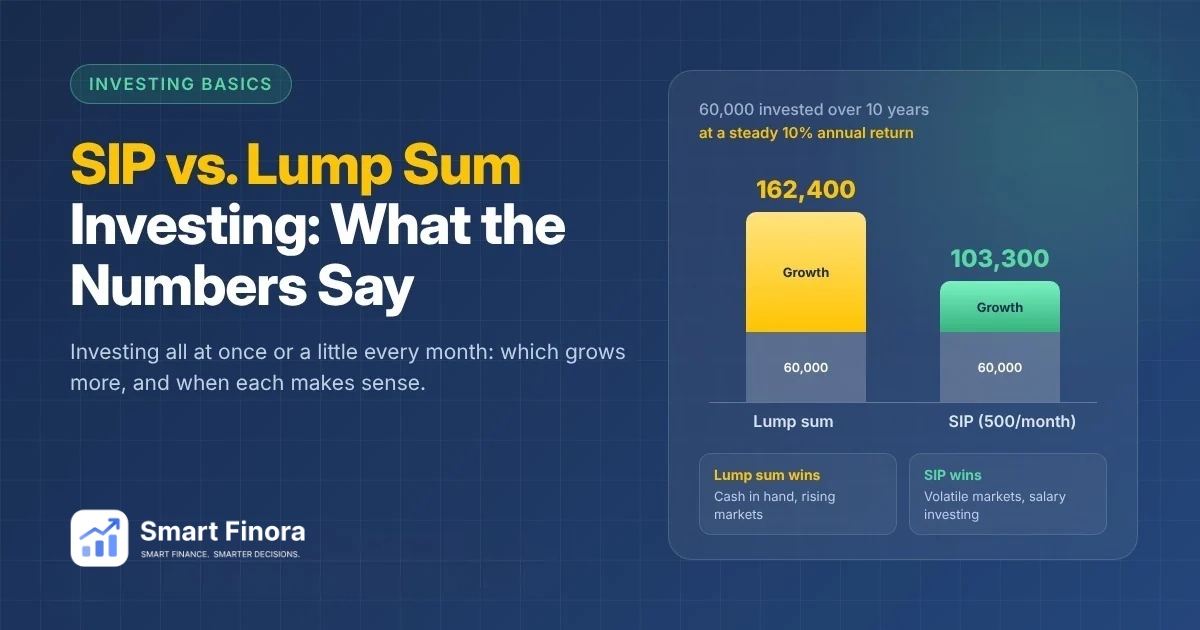
Same 60,000, same 10% return, same 10 years
Investing 60,000 at once and earning 10% a year (compounded monthly) grows to about 162,400 after 10 years. Investing 500 a month for the same 10 years — also 60,000 in total — grows to about 103,300. The lump sum ends up far ahead, because on average each SIP instalment is invested for only about half the period.
This comparison assumes a smooth, constant return. Real markets are not smooth, which is where SIPs earn their place.
Where SIPs shine: volatile and falling markets
A fixed monthly amount buys more units when prices are low and fewer when prices are high. This lowers your average cost per unit when markets swing.
| Month | Price per unit | 1,000 buys | Units |
|---|---|---|---|
| 1 | 100 | 1,000 ÷ 100 | 10.0 |
| 2 | 80 | 1,000 ÷ 80 | 12.5 |
| 3 | 50 | 1,000 ÷ 50 | 20.0 |
| 4 | 100 | 1,000 ÷ 100 | 10.0 |
After four months the SIP investor has spent 4,000 and holds 52.5 units, worth 5,250 at a price of 100 — a 31% gain, even though the price ended where it started. A lump sum of 4,000 in month one would be worth exactly 4,000.
The reverse is also true. If prices climbed steadily — 100, 110, 120, 130 — the SIP would buy about 35.1 units worth roughly 4,566 at the end (+14%), while the lump sum’s 40 units would be worth 5,200 (+30%).
The behavioural case for SIPs
The biggest risk for many investors is not the market but their own reactions. Investing a large sum just before a sharp fall is painful, and some people sell at the bottom and lock in the loss. A SIP reduces that regret and builds a habit that runs automatically.
- It requires no market timing — the date of each instalment is fixed.
- It fits naturally with monthly income.
- It can be increased each year with a step-up, so contributions grow with your salary.
A 10% annual step-up makes a big difference: starting at 500 a month and raising it 10% each year for 20 years, at a 10% return, builds about 807,000 from roughly 344,000 invested, compared with about 383,000 for a flat 500-a-month SIP. You can model this with the step-up option in the SIP Calculator.
How to choose
- Investing from salary? Use a SIP — it is the natural fit.
- Holding a lump sum and comfortable with volatility? Investing it promptly has historically been better on average.
- Holding a lump sum but nervous about timing? A middle path is to invest it over 6–12 months through a systematic transfer from a low-risk fund or savings account.
- Need the money within a few years? Neither — short-term money belongs in low-risk savings, not equities.
Related calculators
Frequently asked questions
Can I stop or pause a SIP?
Usually yes. Most fund platforms let you pause, change or stop a SIP without a penalty, although exit loads or taxes may apply when you redeem units.
Is a SIP risk-free?
No. A SIP is a way of investing, not an investment product. Its risk depends entirely on what you invest in — an equity fund through a SIP is still equity risk.
What is the best date for a SIP?
Over long periods the date makes very little difference. Choose a date shortly after your salary arrives so the money is invested before it is spent.
Sources and references
- Dollar-cost averaging — Investor.gov (U.S. Securities and Exchange Commission)
- Investor education resources — Securities and Exchange Board of India (SEBI)
Figures in examples are calculated with Smart Finora’s calculators and rounded. Read how we research and review content in our editorial policy.
Related calculators
Written by
Calculator methodology and tax rules
The Smart Finora Research Desk builds and tests the formulas behind our calculators, maintains the country-specific tax tables, and reviews them whenever official rates change. Each calculator documents its formula, assumptions and the date its rules were last reviewed.