How Big Should Your Emergency Fund Be?
How to size an emergency fund based on your essential expenses and job security, where to keep it, and how to build it step by step without stalling other goals.
An emergency fund is money set aside for the unexpected: a job loss, a medical bill, an urgent car or home repair. It is not exciting, but it is the foundation that keeps a setback from turning into long-term debt. The right size depends on your expenses and how stable your income is — here is how to work it out.
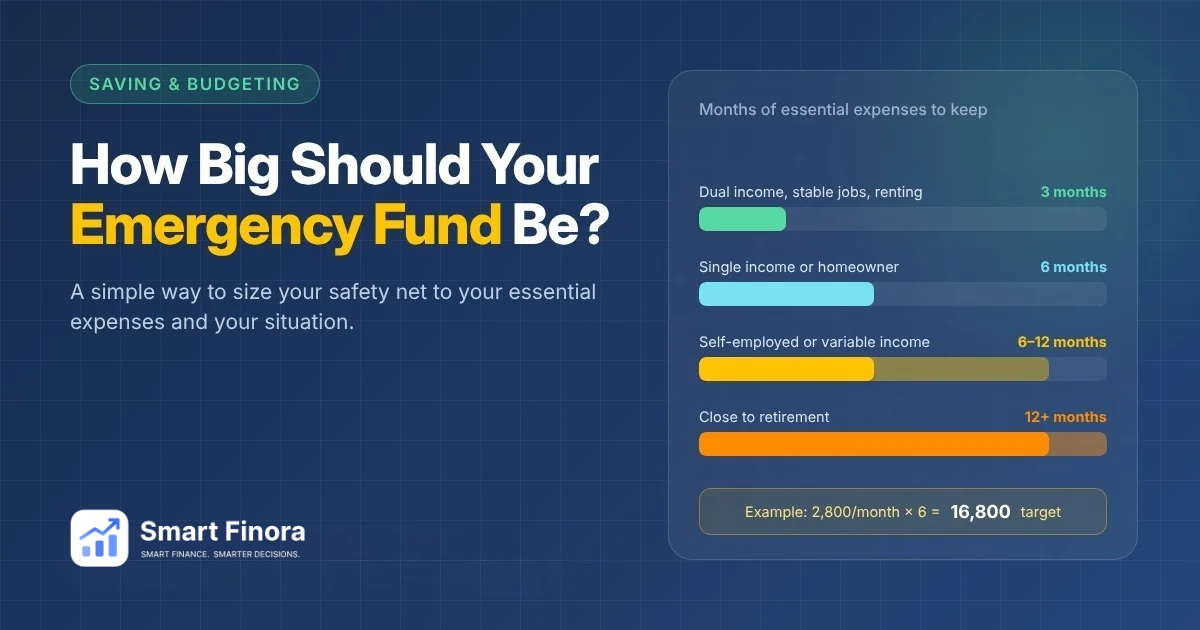
The common guideline: three to six months
The most widely quoted rule is to keep three to six months of essential expenses in an emergency fund. Note the word essential. In a genuine emergency you would cut back on dining out, holidays and new purchases, so the fund only needs to cover what you cannot avoid: housing, utilities, food, transport, insurance and minimum debt payments.
For many households, essential expenses are 60–75% of total spending, which makes the target noticeably smaller — and more achievable — than “six months of income”.
Adjust the target for your situation
Three months may be plenty for some people and far too little for others. Consider moving toward the higher end, or beyond, if any of these apply:
- You are self-employed, a freelancer or paid mainly by commission
- You are the only earner in your household, or you support dependants
- You work in an industry with frequent layoffs or long hiring cycles
- You own a home or an older car, where large repairs are more likely
- You have a health condition that could lead to unexpected costs or time off work
Two stable incomes, a secure job and good insurance cover can justify a smaller fund. There is no single right answer — the aim is a cushion that lets you sleep at night without leaving years of savings idle in cash.
| Situation | Suggested cover |
|---|---|
| Dual income, stable jobs, renting | 3 months |
| Single income or homeowner | 6 months |
| Self-employed or variable income | 6–12 months |
| Close to retirement | 12 months or more, to avoid selling investments in a downturn |
A worked example
Example
Sizing and building the fund
Essential expenses come to 2,800 a month and you want six months of cover, so the target is 2,800 × 6 = 16,800. You already have 1,500 saved, leaving 15,300 to build. Setting aside 450 a month gets you there in 34 months — just under three years.
That may feel slow. Two things help: a starter goal (for example one month of expenses) gives an early win, and windfalls such as tax refunds or bonuses can shorten the timeline dramatically. Try different amounts in the Emergency Fund Calculator.
Where to keep your emergency fund
An emergency fund has three requirements, in this order: it must be safe, it must be accessible within a day or two, and ideally it should earn some interest so inflation does not erode it.
- High-yield or easy-access savings accounts are the usual choice: no risk to the balance and instant access.
- Short-term fixed deposits or CDs can pay more, but early-withdrawal penalties apply. Some people keep one month in an instant-access account and ladder the rest across short deposits.
- Avoid shares and equity funds for this money. Their value can fall sharply at exactly the moment an economic downturn puts your job at risk.
Emergency fund or debt repayment first?
If you have high-interest debt, such as credit card balances, it can feel wrong to hold cash earning a few percent while paying over 20% on a card. A balanced approach works well for most people:
- Build a starter fund of about one month’s essential expenses, so a surprise bill doesn’t go back on the card.
- Put extra money toward high-interest debt until it is cleared.
- Then complete the full emergency fund, before moving on to longer-term investing.
Finally, define what counts as an emergency before you need the money. A job loss, a medical bill or an essential repair qualifies; a sale or a holiday does not. If you do use the fund, make rebuilding it your first savings priority.
Related calculators
Frequently asked questions
Should an emergency fund cover income or expenses?
Essential expenses. You do not need to replace your full income, because in an emergency you can pause discretionary spending and saving.
Is an emergency fund still needed if I have a credit card?
Yes. Credit can disappear when you need it most (limits can be reduced), and borrowing at high interest during a crisis makes recovery harder.
Does my emergency fund count toward retirement savings?
No. Keep it separate. Retirement savings are meant to be invested for the long term, and withdrawing early can bring taxes and penalties.
Sources and references
- Deposit insurance — how your money is protected — Federal Deposit Insurance Corporation (FDIC)
- Financial Services Compensation Scheme — FSCS (UK)
- Emergency savings guidance — MoneyHelper (UK Money and Pensions Service)
Figures in examples are calculated with Smart Finora’s calculators and rounded. Read how we research and review content in our editorial policy.
Related calculators
Written by
Personal finance writers and editors
The Smart Finora Editorial Team writes and maintains our finance guides. Every guide is researched from primary sources such as government agencies, central banks and regulators, checked against our calculators, and reviewed before publication under our editorial policy.