How Loan EMIs Work: Principal, Interest and Amortization Explained
Understand how an EMI is calculated, why early payments are mostly interest, and how the loan term and extra payments change the total cost of a loan.
Whether it is called an EMI, a monthly instalment or simply a loan payment, the fixed amount you repay each month on most loans follows the same mathematics. Once you understand how it is built, it becomes much easier to compare offers, choose a sensible term, and decide whether paying extra is worth it.
What an EMI is
An EMI (Equated Monthly Instalment) is a fixed payment that covers two things every month: the interest charged on the outstanding balance for that month, and a portion of the principal — the amount you originally borrowed. Because the payment is fixed but the balance shrinks, the split between interest and principal changes over time. This is called amortization.
Most home loans, car loans, personal loans and education loans around the world use this reducing-balance method.
The formula behind the payment
The monthly payment is: EMI = P × r × (1 + r)ⁿ ÷ [(1 + r)ⁿ − 1], where P is the loan amount, r is the monthly interest rate (annual rate ÷ 12 ÷ 100) and n is the number of monthly payments.
The formula finds the one fixed payment that reduces the balance to exactly zero after n months. You never need to calculate it by hand — the EMI Calculator does it instantly — but knowing the inputs helps: the payment rises with the loan amount and the interest rate, and falls as the term gets longer.
Why early payments are mostly interest
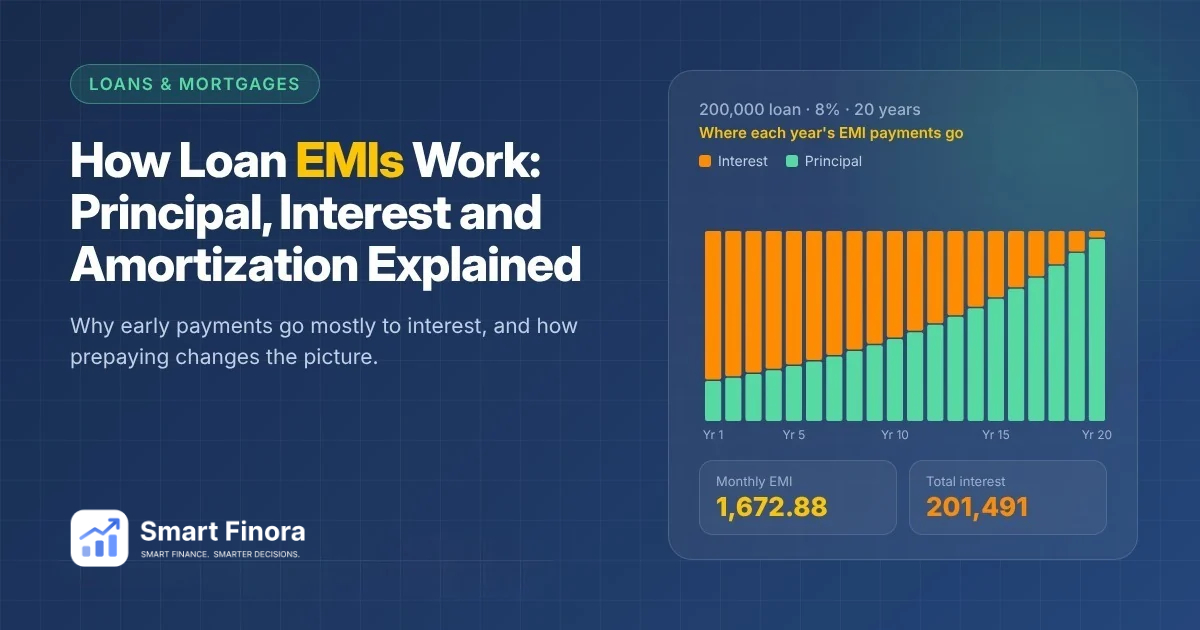
Interest each month is simply the outstanding balance × the monthly rate. At the start, the balance is at its highest, so interest takes the largest share of the payment. As principal is repaid, interest shrinks and the principal share grows.
Example
200,000 borrowed at 8% for 20 years
The monthly payment is 1,672.88. In the first month, interest is 200,000 × 0.08 ÷ 12 = 1,333.33, so only 339.55 reduces the balance. Over the whole first year, about 15,847 of the 20,075 paid is interest. By year 20, interest is only about 843 of the year’s payments. Across the full term you pay 201,491 in interest — slightly more than the amount borrowed.
This is why the outstanding balance falls slowly at first and quickly at the end, and why refinancing or prepaying early in a loan has the biggest effect.
Loan term: lower payments vs. lower total cost
A longer term spreads the principal over more months, which lowers the payment — but interest is charged for longer, so the total cost rises.
| Same 200,000 loan at 8% | Monthly payment | Total interest |
|---|---|---|
| 15-year term | 1,911.30 | 144,035 |
| 20-year term | 1,672.88 | 201,491 |
Stretching the term by five years lowers the payment by about 238 a month but adds over 57,000 of interest. A sensible approach is to choose the shortest term whose payment fits comfortably in your budget, leaving room for an emergency fund and other goals.
The power of extra payments
Any extra payment goes straight to principal, which reduces the interest charged in every following month. On the 20-year example above, paying an extra 200 a month clears the loan in 188 months instead of 240 — more than four years sooner — and saves about 50,700 in interest.
You can test your own numbers with the Loan Payoff Calculator.
Comparing loan offers
- Compare APR, not just the interest rate. APR includes certain fees, such as origination or processing charges, and reflects the true yearly cost.
- Check whether the rate is fixed or floating. A floating rate can rise, increasing either your payment or your term.
- Look at total cost. A slightly lower payment can hide a much longer term.
- Read the fine print on fees. Late payment, prepayment and foreclosure charges vary widely between lenders.
Related calculators
Frequently asked questions
Does my EMI change if interest rates change?
On a fixed-rate loan, no. On a floating-rate loan, lenders usually either change the EMI or keep it the same and extend the term. Ask your lender which approach they use.
Is it better to reduce my EMI or my term after a prepayment?
Reducing the term saves more interest. Reducing the EMI improves monthly cash flow. If your budget is comfortable, keeping the EMI and shortening the term is usually the cheaper choice.
What happens if I miss an EMI?
You will usually pay a late fee and extra interest, and the missed payment may be reported to credit bureaus, lowering your credit score. Contact your lender early if you expect difficulty.
Sources and references
- Owning a home: tools and guides for mortgage borrowers — Consumer Financial Protection Bureau
- Reserve Bank of India — consumer education — Reserve Bank of India
Figures in examples are calculated with Smart Finora’s calculators and rounded. Read how we research and review content in our editorial policy.
Related calculators
Written by
Calculator methodology and tax rules
The Smart Finora Research Desk builds and tests the formulas behind our calculators, maintains the country-specific tax tables, and reviews them whenever official rates change. Each calculator documents its formula, assumptions and the date its rules were last reviewed.