GST, VAT and Sales Tax: How Consumption Taxes Differ
How GST, VAT and sales tax work, why they are collected differently, and how to add or remove tax from a price correctly — with examples from several countries.
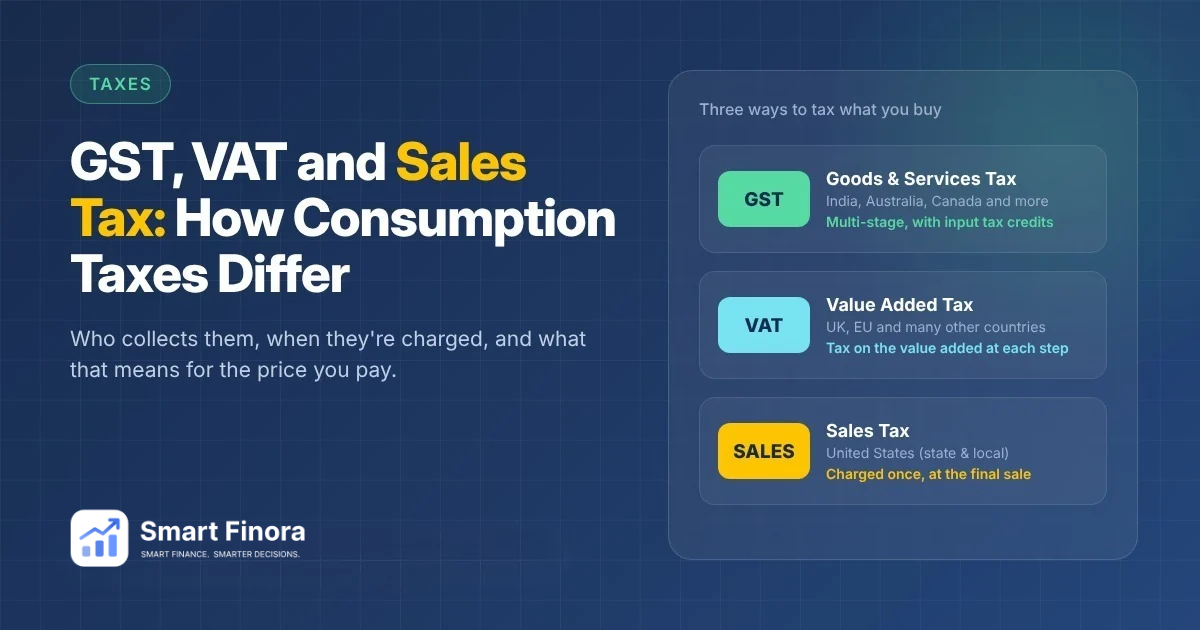
Almost every country taxes spending as well as income. Depending on where you live, the tax on your receipt may be called GST, VAT or sales tax. They all raise the price you pay, but they are collected in different ways — and knowing the difference helps whether you are shopping, running a business, or simply checking an invoice.
VAT and GST: tax at every stage
Value Added Tax (VAT) and Goods and Services Tax (GST) are essentially the same type of tax under different names. VAT is used across the UK and the European Union; GST is used in India, Australia, New Zealand, Canada, Singapore and elsewhere.
Tax is charged at every stage of the supply chain, but each business can claim a credit for the tax it paid on its own purchases. In effect, each business pays tax only on the value it adds, and the full burden falls on the final consumer.
Example
VAT through a supply chain (20% rate)
A manufacturer sells materials to a furniture maker for 100 plus 20 VAT. The maker sells a table to a shop for 300 plus 60 VAT, claims back the 20 it paid, and passes 40 to the tax authority. The shop sells the table to a customer for 500 plus 100 VAT, claims back 60, and passes on 40. The authority receives 20 + 40 + 40 = 100 in total — exactly 20% of the final price — and the customer bears all of it.
Sales tax: tax at the final sale
A retail sales tax, used in most US states, is charged only once: when goods are sold to the end consumer. Businesses buying for resale usually provide an exemption certificate instead of paying the tax.
In the US there is no national sales tax. States set a base rate, and counties, cities and special districts can add their own, so the combined rate can differ between neighbouring towns. US prices are usually displayed before tax, while VAT and GST countries often display prices including tax for consumers.
Examples of standard rates
| Country | Tax | Standard rate |
|---|---|---|
| United Kingdom | VAT | 20% |
| Germany | VAT | 19% |
| France | VAT | 20% |
| Ireland | VAT | 23% |
| India | GST | 5% and 18% main slabs; 40% on selected goods |
| Australia | GST | 10% |
| New Zealand | GST | 15% |
| Canada | GST (federal) | 5%, plus provincial PST or combined HST in many provinces |
| United Arab Emirates | VAT | 5% |
Most countries also have reduced or zero rates for essentials such as basic food, medicine or children’s goods. India restructured its GST rates in September 2025, moving most goods into 5% and 18% slabs. Always check the rate that applies to the specific product or service.
How to add and remove tax correctly
Adding tax is straightforward: gross price = net price × (1 + rate). At 18% GST, a 1,000 net price becomes 1,180.
Removing tax is where people go wrong. You must divide by (1 + rate), not subtract the percentage. The tax was calculated on the smaller net price, so taking 20% off a VAT-inclusive price removes too much.
Example
Removing 20% VAT from 120
Correct: 120 ÷ 1.20 = 100 net, so VAT is 20. Incorrect: 120 − 20% = 96, which would imply VAT of 24. At a 20% rate, the VAT in any gross price is always one sixth of it.
The GST Calculator, VAT Calculator and Sales Tax Calculator handle both directions.
India’s CGST, SGST and IGST
In India, GST on a sale within one state is split equally between the central and state governments as CGST and SGST (or UTGST in union territories). On a sale between states, the full amount is charged as IGST. The customer pays the same total either way; only the accounting differs.
Related calculators
Frequently asked questions
Do tourists pay VAT?
Visitors pay VAT on purchases, but some countries offer refunds on eligible goods taken out of the country. Rules and minimum amounts vary.
Who must register for VAT or GST?
Businesses above a turnover threshold must usually register and charge tax. Thresholds differ by country and sometimes by type of business.
Is sales tax charged on services?
It depends on the state. Many US states tax most goods but only some services. VAT and GST systems usually cover both goods and services.
Sources and references
- VAT rates — GOV.UK
- Goods and Services Tax — Australian Taxation Office
- GST portal — Goods and Services Tax Network, India
Figures in examples are calculated with Smart Finora’s calculators and rounded. Read how we research and review content in our editorial policy.
Related calculators
Written by
Calculator methodology and tax rules
The Smart Finora Research Desk builds and tests the formulas behind our calculators, maintains the country-specific tax tables, and reviews them whenever official rates change. Each calculator documents its formula, assumptions and the date its rules were last reviewed.