Taxes
GST, VAT and Sales Tax: How Consumption Taxes Differ
How GST, VAT and sales tax work, why they are collected differently, and how to add or remove tax from a price correctly — with examples from several countries.
3 min read
GST (Goods and Services Tax) is a consumption tax charged in many countries, including India, Australia, New Zealand and Canada. Choose a rate, then add GST to a net price or extract it from a GST-inclusive price.
$1,180.00
Add: GST = Net × rate ÷ 100. Remove: Net = Gross ÷ (1 + rate ÷ 100)
To remove GST you divide rather than subtract a percentage: taking 18% off a GST-inclusive price would remove too much, because the GST was calculated on the smaller net price.
Adding 18% GST to a net price of $1,000 gives $180.00 of GST and a total of $1,180.00. For a sale within one state this is split into $90.00 CGST and $90.00 SGST.
In India, a sale within one state is split equally into Central GST and State GST. A sale between states is charged as Integrated GST (IGST) at the full rate.
Divide the total by (1 + rate ÷ 100) to get the net price, then subtract it from the total to get the GST. Choose “Remove GST” above to do this automatically.
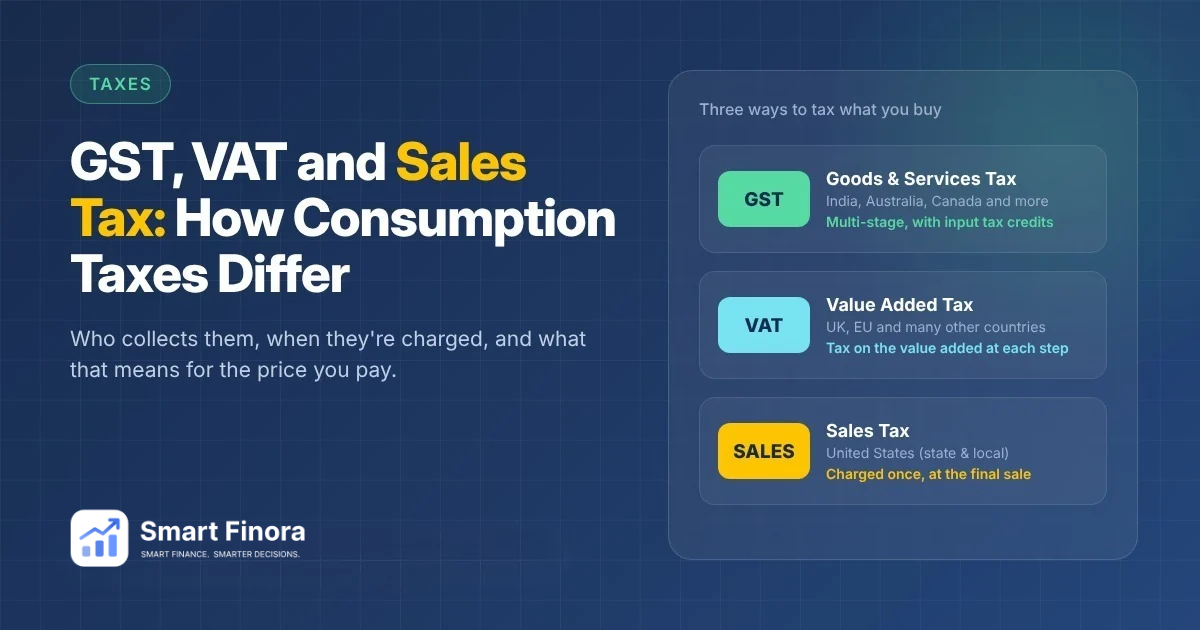
Both are multi-stage consumption taxes and work in almost the same way. Different countries simply use different names.
Taxes
How GST, VAT and sales tax work, why they are collected differently, and how to add or remove tax from a price correctly — with examples from several countries.
3 min read