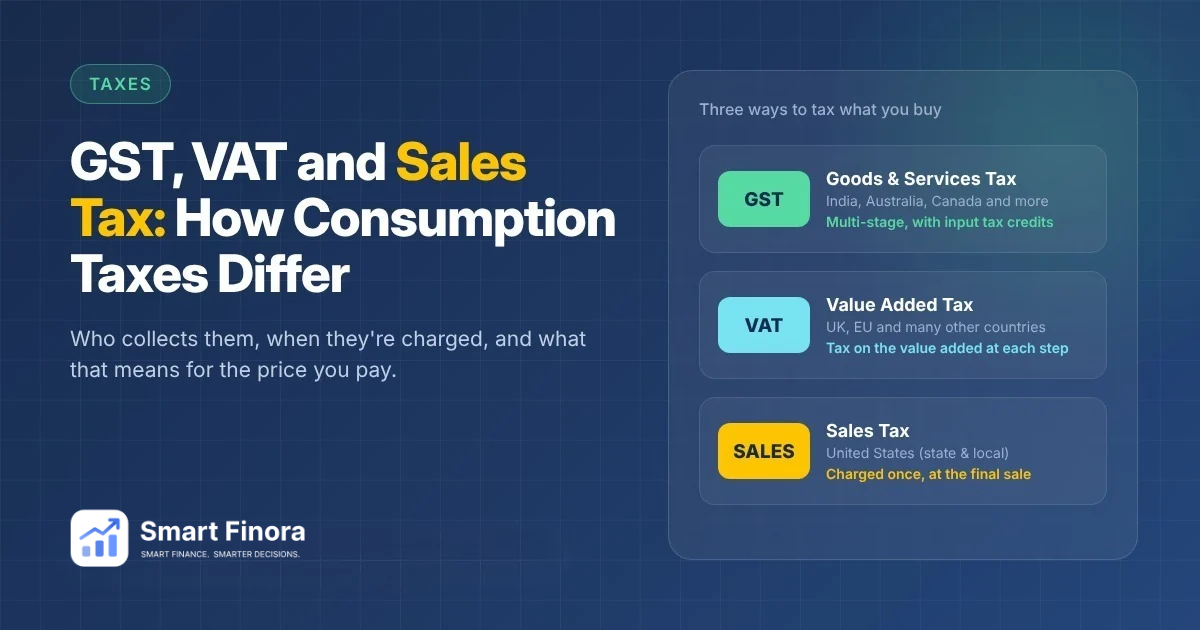
Taxes
GST, VAT and Sales Tax: How Consumption Taxes Differ
How GST, VAT and sales tax work, why they are collected differently, and how to add or remove tax from a price correctly — with examples from several countries.
3 min read
Value Added Tax is charged on most goods and services in the UK, the EU and many other countries. Choose a standard rate or enter your own, then add VAT to a net price or extract it from a VAT-inclusive price.
$1,200.00
Add: VAT = Net × rate ÷ 100. Remove: Net = Gross ÷ (1 + rate ÷ 100)
At 20% VAT, the VAT inside a gross price is gross ÷ 6 (because 20 ÷ 120 = 1/6), not 20% of the gross.
Removing 20% VAT from a gross price of $120 gives a net price of $100.00 and VAT of $20.00 — one sixth of the total, not 20% of it.
Divide the VAT-inclusive price by 1.2. For example, £120 ÷ 1.2 = £100 net, so the VAT is £20.
The final consumer bears the cost. Businesses collect VAT on sales and reclaim VAT paid on their purchases, paying the difference to the tax authority.
Yes. For example, the UK has a 5% reduced rate and a 0% rate for certain goods. Use the custom rate option for these.
Taxes
How GST, VAT and sales tax work, why they are collected differently, and how to add or remove tax from a price correctly — with examples from several countries.
3 min read