How Tax Brackets Work: Marginal vs. Effective Tax Rate
Why moving into a higher tax bracket never reduces your take-home pay, how marginal and effective rates differ, with worked examples for the US, UK and India.
One of the most persistent money myths is that a pay rise can push you into a higher tax bracket and leave you with less money. In a progressive income tax system that simply is not how it works. Understanding brackets — and the difference between your marginal and effective tax rate — makes decisions about raises, overtime and retirement contributions much easier.
Progressive tax in one sentence
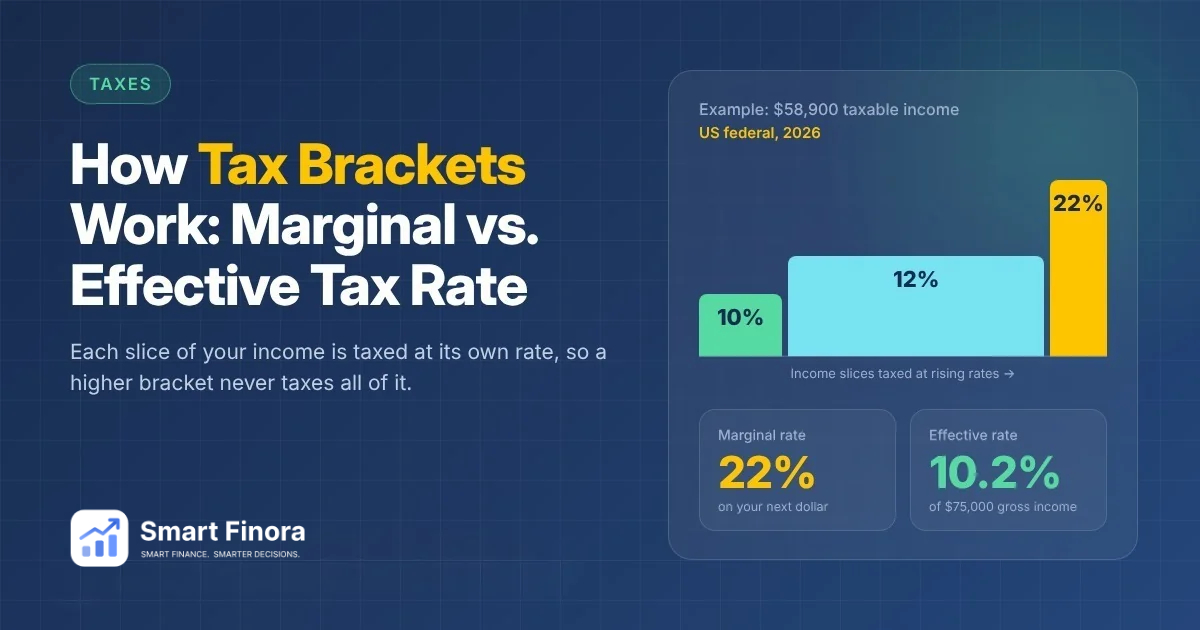
In a progressive system, each slice of your income is taxed at the rate for that slice. Moving into a higher bracket only raises the rate on the income inside the new bracket — everything below it is taxed exactly as before.
Think of brackets as a series of buckets. Your income fills the first bucket (taxed at the lowest rate), then overflows into the second, and so on. Only the money in each bucket is taxed at that bucket’s rate.
Marginal vs. effective tax rate
- Your marginal tax rate is the rate on your next unit of income — the rate of the highest bracket you reach. It is what matters for decisions about extra income or deductions.
- Your effective tax rate is your total income tax divided by your total income. It is always lower than your marginal rate in a progressive system, and it is the better measure of your overall tax burden.
Example: United States (federal, tax year 2026)
A single filer earning $75,000 in 2026 first subtracts the $16,100 standard deduction, leaving $58,900 of taxable income. That income is taxed in slices:
| Bracket | Income in bracket | Tax |
|---|---|---|
| 10% (up to $12,400) | $12,400 | $1,240 |
| 12% ($12,400 – $50,400) | $38,000 | $4,560 |
| 22% ($50,400 – $105,700) | $8,500 | $1,870 |
| Total | $58,900 | $7,670 |
This person is “in the 22% bracket” — their marginal rate — but their federal income tax is $7,670, an effective rate of about 10.2% of gross income. State taxes, Social Security and Medicare are separate.
Example: United Kingdom (2026/27)
In England, Wales and Northern Ireland, the first £12,570 is covered by the Personal Allowance. On a £60,000 salary, the next £37,700 is taxed at 20% (£7,540) and the remaining £9,730 at 40% (£3,892), for £11,432 of income tax — an effective rate of about 19%.
Example: India (FY 2026-27, new regime)
Under India’s new regime, salaried taxpayers get a ₹75,000 standard deduction, and a rebate under Section 87A means no tax is payable when taxable income is up to ₹12 lakh. On a salary of ₹15 lakh, taxable income is ₹14.25 lakh. Slab tax is ₹0 on the first ₹4 lakh, ₹20,000 on the next ₹4 lakh (5%), ₹40,000 on the next ₹4 lakh (10%) and ₹33,750 on the last ₹2.25 lakh (15%) — ₹93,750 in total. Adding 4% cess gives ₹97,500, an effective rate of 6.5%.
Just above ₹12 lakh of taxable income, marginal relief ensures the tax does not exceed the income above ₹12 lakh, so there is no cliff edge where earning slightly more leaves you worse off.
Why this matters for your decisions
- Never turn down a raise because of brackets. You keep the raise minus tax at your marginal rate.
- Value deductions at your marginal rate. A pre-tax retirement contribution of 1,000 saves 220 of US federal tax for someone in the 22% bracket.
- Use the effective rate for budgeting. It shows what share of your total income goes to income tax.
The Income Tax Calculator shows a band-by-band breakdown for the US, UK and India, and the Gross to Net Salary Calculator adds payroll taxes to estimate take-home pay.
Related calculators
Frequently asked questions
Can a raise ever reduce my take-home pay?
Not through income tax brackets alone. It can happen in rare cases where income-tested benefits or credits are withdrawn, which effectively raises your marginal rate.
Are tax brackets adjusted for inflation?
In the US, federal brackets are adjusted for inflation each year. In the UK, thresholds have been frozen for several years, which gradually pulls more income into higher bands. India changes slabs through the annual budget.
Do brackets apply to all types of income?
Not always. Capital gains and dividends are often taxed under separate rules and rates. This guide covers ordinary income such as salary.
Sources and references
- Federal income tax rates and brackets — Internal Revenue Service (IRS)
- Income Tax rates and Personal Allowances — GOV.UK
- Income Tax Department e-filing portal — Income Tax Department, Government of India
Figures in examples are calculated with Smart Finora’s calculators and rounded. Read how we research and review content in our editorial policy.
Related calculators
Written by
Calculator methodology and tax rules
The Smart Finora Research Desk builds and tests the formulas behind our calculators, maintains the country-specific tax tables, and reviews them whenever official rates change. Each calculator documents its formula, assumptions and the date its rules were last reviewed.