Managing Monthly Bills: A Simple System to Never Miss a Payment
Set up a simple bill system: list every bill, line due dates up with payday, use a bills account and autopay safely, and cut costs at every renewal.
Late fees, missed payments and bills that quietly creep up at renewal are expensive and avoidable. A simple bill system takes an hour to set up and then runs almost by itself. Here is how to build one.
List every bill in one place
Go through two or three months of bank statements and write down every recurring payment: what it is for, the amount, the due date, how it is paid and when the contract ends. Include bills paid yearly or quarterly — they are the ones most likely to surprise you.
| Bill | Amount | Due | Paid by | Renews |
|---|---|---|---|---|
| Rent | 1,200 | 1st | Standing order | Lease ends June |
| Electricity | 85 | 15th | Direct debit / autopay | Variable |
| Phone | 25 | 20th | Card | Monthly |
| Car insurance | 780 | Yearly, March | Card | March |
Line due dates up with payday
Many providers let you choose your payment date. Moving most bills to the few days after payday means the money is always there when they are due, and what is left afterwards is genuinely yours to spend.
If you are paid weekly or every two weeks, group bills into two halves of the month and set aside the right share from each paycheck.
Use a separate bills account
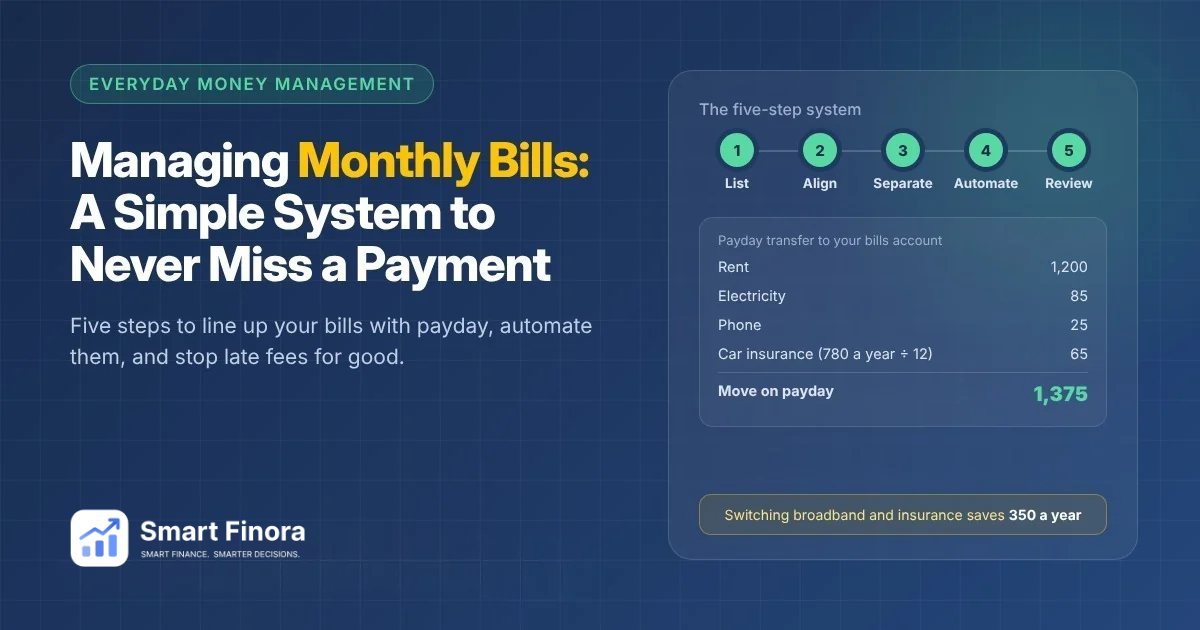
Open a second account used only for bills. On payday, transfer the total of the month’s bills — plus one-twelfth of yearly bills — into it. Everyday spending happens from your main account, so you can never accidentally spend the rent.
- Open a separate current account just for bills.
- Move every bill’s payment details to the new account.
- Add up the month’s bills plus one-twelfth of your yearly bills.
- Set a standing order for that total on payday.
- Add a small cushion and turn on low-balance alerts.
Automate — carefully
- Fixed bills (rent, loans, subscriptions) are ideal for automatic payment.
- Variable bills (energy, card balances) can also be automated, but check them each month for errors or unexpected jumps.
- Credit cards: automate at least a fixed amount, ideally the full statement balance.
- Alerts: turn on low-balance alerts so an automatic payment never pushes you into an overdraft.
Review every renewal
Providers often save their best prices for new customers. A reminder a month before each contract ends gives you time to compare and negotiate.
Example
Two phone calls, one year
Switching broadband from 45 to 30 a month saves 180 a year, and comparing quotes cuts car insurance at renewal from 780 to 610 — another 170. Together that is 350 a year for about an hour of work.
Add your bills to the Monthly Expense Calculator to see their total impact, including yearly ones.
Common mistakes
- Autopay into an empty account, which can trigger overdraft and failed-payment fees.
- Ignoring price rises at renewal. Auto-renewal often means paying more for the same service.
- Paying yearly bills monthly with interest. Some insurers charge interest for paying in instalments; paying yearly from a sinking fund can be cheaper.
- Forgetting free trials that turn into paid subscriptions.
- No record of contract end dates, so the best time to switch passes unnoticed.
Related calculators
Frequently asked questions
Should I put all my bills on autopay?
Fixed bills, yes. For variable bills, autopay is convenient but check each statement. Make sure the paying account always has enough money.
What should I do if I can’t pay a bill?
Contact the provider before the due date. Many offer payment plans or hardship support, and it is usually easier to arrange before a payment is missed.
How do I handle bills that come once a year?
Divide the yearly cost by 12 and save that amount monthly in your bills account or a sinking fund.
Sources and references
- Everyday money and bills guidance — MoneyHelper (UK Money and Pensions Service)
- Consumer advice — Federal Trade Commission (US)
Figures in examples are calculated with Smart Finora’s calculators and rounded. Read how we research and review content in our editorial policy.
Related calculators
Written by
Personal finance writers and editors
The Smart Finora Editorial Team writes and maintains our finance guides. Every guide is researched from primary sources such as government agencies, central banks and regulators, checked against our calculators, and reviewed before publication under our editorial policy.