Insurance Planning: Which Policies You Need at Each Life Stage
A simple framework for insurance planning: insure what you can’t afford to lose, set priorities by life stage, avoid overlapping cover and review yearly.
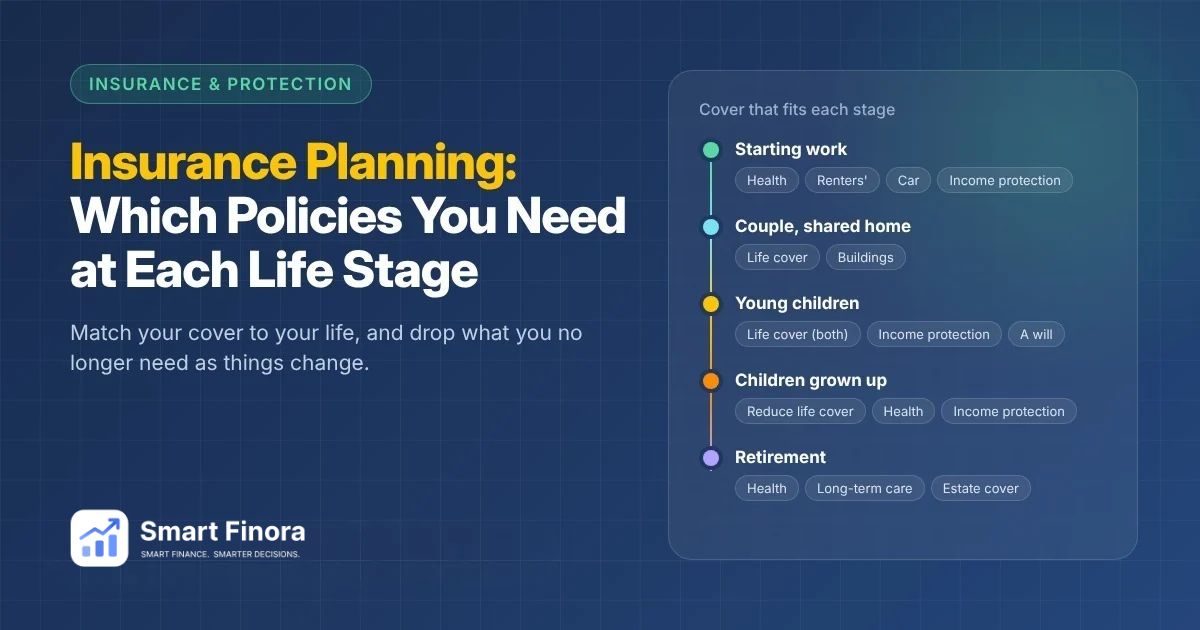
Insurance planning is about matching cover to real risks: enough protection that one bad event cannot ruin your finances, without paying for policies you do not need. The right mix changes as your life does, so it helps to think in life stages.
The core principle: insure what you can’t afford to lose
Insurance is worth it for losses that would be financially devastating and unlikely — a serious illness, a disability that stops you working, a death that leaves dependants without income, a lawsuit after a car accident. Small, likely losses — a broken phone, a minor repair — are usually cheaper to cover from savings.
Typical priorities
- Legally required cover, such as third-party car insurance in most countries.
- Health insurance, where public healthcare does not cover essential treatment.
- Income protection or disability insurance, because your ability to earn is usually your biggest asset.
- Life insurance, if anyone depends on your income.
- Home or renters’ contents insurance, to replace belongings and cover liability.
Insurance by life stage
| Life stage | Common priorities |
|---|---|
| Starting work, no dependants | Health cover where needed, contents or renters’ insurance, car insurance, income protection |
| Couple, shared home | Add life cover if one income pays most of the mortgage; buildings insurance for owners |
| Young children | Life cover for both parents, income protection, a will and named guardians |
| Children grown up | Reduce life cover as debts fall; keep health and income protection |
| Retirement | Health cover and long-term care planning; life cover mainly for estate needs |
An annual insurance review
- List every policy, its cover, cost and renewal date.
- Check for overlaps — for example travel cover included with a bank account or card.
- Check whether cover still matches your life: new home, child, job or debts.
- Compare prices at renewal rather than auto-renewing.
- Update beneficiaries and keep documents where your family can find them.
Example
Finding overlap
A household pays for separate gadget insurance and travel insurance, but their home contents policy already covers gadgets away from home and their bank account includes travel cover. Cancelling the duplicates saves the full cost of both policies with no loss of protection.
Local rules matter
Common mistakes
- Over-insuring small things such as extended warranties and gadget cover.
- Under-insuring income, the risk most people forget.
- Duplicate policies through work, bank accounts and cards.
- Not disclosing information, which can lead to refused claims.
- Auto-renewing for years without checking price or cover.
Related calculators
Frequently asked questions
What is income protection insurance?
It pays part of your income if illness or injury stops you working, usually after a waiting period. Names and features vary by country; it may be called disability insurance.
How much should I spend on insurance?
There is no fixed percentage. Focus on covering major risks well and dropping cover for small losses you could pay from savings.
Is my employer’s cover enough?
It is a valuable start, but it often ends when you leave the job and may not be enough for your needs. Check what it covers and consider topping up.
Sources and references
- Consumer information on insurance — Financial Conduct Authority (UK)
- Insurance guidance — Moneysmart (Australian Securities and Investments Commission)
- Insurance and consumer protection — Financial Consumer Agency of Canada
Figures in examples are calculated with Smart Finora’s calculators and rounded. Read how we research and review content in our editorial policy.
Related calculators
Written by
Calculator methodology and tax rules
The Smart Finora Research Desk builds and tests the formulas behind our calculators, maintains the country-specific tax tables, and reviews them whenever official rates change. Each calculator documents its formula, assumptions and the date its rules were last reviewed.