Buying Your First Home: A Step-by-Step Financial Guide
A financial guide to buying your first home: check you are ready, save a deposit, budget for upfront and ongoing costs, see what you can afford and compare mortgages.
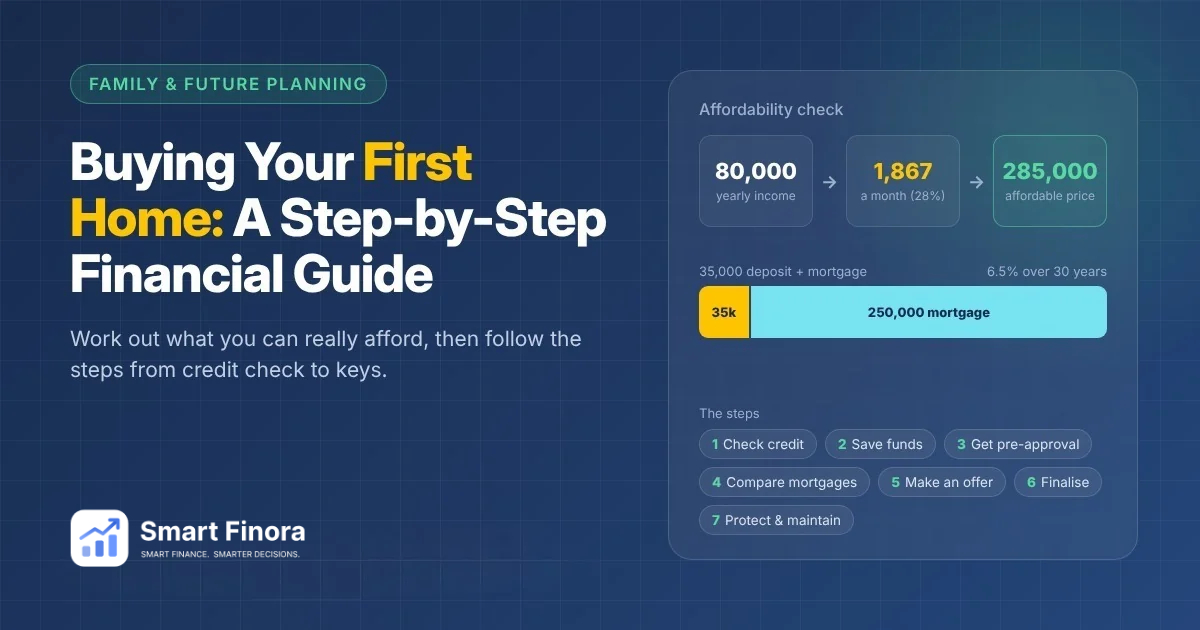
Buying your first home is usually the biggest purchase you will ever make. The process and costs differ between countries, but the financial questions are the same everywhere: are you ready, how much can you sensibly spend, and what will it really cost — upfront and every month?
Are you financially ready?
- Stable income, and plans to stay in the area for several years.
- A deposit saved, plus money for buying costs.
- An emergency fund that will still be there after you buy.
- Manageable existing debts and a clean credit history.
- A budget that can absorb a mortgage payment, maintenance and higher bills.
If you might move within a few years, renting can work out cheaper because buying and selling costs are paid once. The Rent vs Buy Calculator compares both for your situation.
Saving the deposit
Minimum deposits vary by country and loan type, from around 5% for some loans to 20% or more. A larger deposit means a smaller loan, a lower monthly payment, often a better interest rate, and in some countries avoiding mortgage insurance.
Many countries offer first-time buyer schemes, tax-advantaged deposit savings accounts or reduced transfer taxes. Eligibility and rules vary, so check official government sources.
Work out what you can afford
Example
An affordability check
A household earns 80,000 a year (about 6,667 a month), pays 300 a month on other debts and has a 35,000 deposit. Using common US lending guidelines — housing costs up to 28% of gross income and all debts up to 36% — the housing limit of about 1,867 a month applies. At 6.5% over 30 years, with property tax and insurance of 1.2% of the price a year, that supports a home of about 285,000 with a loan of about 250,000.
Lenders in other countries use different tests, such as income multiples or limits on total loan payments. Try your own numbers, and adjust the limits, with the Home Affordability Calculator. The maximum a lender offers is not necessarily what you should borrow.
Budget for the full cost
Upfront costs
Besides the deposit: transfer taxes or stamp duty where they apply, legal or conveyancing fees, valuation and survey fees, mortgage arrangement fees, moving costs and initial furnishing. These often add several percent of the price.
Ongoing costs
The mortgage payment, property tax or local council tax, building insurance, service charges where relevant, utilities and maintenance. A common rule of thumb is to budget 1–2% of the home’s value a year for repairs and upkeep.
Step by step
- Check your credit report and correct any errors.
- Save your deposit, buying costs and an emergency fund.
- Get a mortgage agreement in principle or pre-approval to know your budget.
- Compare mortgages by APR, fees, fixed vs variable rates and early-repayment terms.
- Make an offer and arrange a survey or inspection.
- Finalise the mortgage and complete the legal process.
- Set up insurance and a home maintenance fund.
Common mistakes
- Borrowing the maximum and leaving no room for savings or rate rises.
- Forgetting buying costs, so the deposit falls short at the last minute.
- Draining the emergency fund for the purchase.
- Skipping the survey or inspection to save money.
- Comparing mortgages only on the headline rate instead of total cost.
Related calculators
Frequently asked questions
How much deposit do I need for a first home?
It depends on the country and loan type, from around 5% to 20% or more. A bigger deposit reduces your loan and often your interest rate.
Should I choose a fixed or variable rate?
A fixed rate gives certainty over payments for a set period; a variable rate can fall or rise with market rates. The right choice depends on your budget’s ability to absorb increases.
Is it better to rent or buy?
It depends on prices, rents, interest rates and how long you will stay. Buying usually works better the longer you stay.
Sources and references
- Owning a home: tools and guides — Consumer Financial Protection Bureau (US)
- Buying a home guidance — MoneyHelper (UK Money and Pensions Service)
- Buying a home — Moneysmart (Australian Securities and Investments Commission)
Figures in examples are calculated with Smart Finora’s calculators and rounded. Read how we research and review content in our editorial policy.
Related calculators
Written by
Personal finance writers and editors
The Smart Finora Editorial Team writes and maintains our finance guides. Every guide is researched from primary sources such as government agencies, central banks and regulators, checked against our calculators, and reviewed before publication under our editorial policy.