Skip to content

Home Affordability Calculator

How much house can you afford? This calculator uses two income-based limits that lenders commonly apply: the share of gross income for housing costs, and the share for all debt payments combined. Enter your income, existing debts, down payment and loan terms to see the price that fits within both — and adjust the limits to match your lender or country.

  • Private — runs in your browser
  • Formula explained

Enter your details

$
$

Car, student, card minimums and other loan payments — not rent.

$

Keep extra cash aside for closing costs, moving and an emergency fund.

Mortgage

%
years
%

Ongoing costs of owning. Varies widely by location — check local property tax and insurance.

Lending limits

%

28% is a common US guideline. Use your lender’s figure if you know it.

%

36% is a common US guideline; some lenders allow 43% or more.

Calculated in your browser. Your numbers are never sent or stored.

Home price you can afford

$330,029

Mortgage amount
$280,029
Monthly housing payment
$2,100.00
Down payment share of price
15.15%
Limit that applies
Housing cost (28% of income)

These are borrowing limits, not a recommendation. A home that costs less leaves room for savings, repairs and rate rises.

Lenders outside the US often use different tests — for example a maximum of about 4–4.5 times income in the UK, or a cap on total EMIs as a share of take-home pay in India. Adjust the limits above to match.

Monthly housing payment

How the limit is worked out

Swipe the table sideways to see every column.

RuleMaximum monthly housing payment
Housing: 28% of gross income$2,100
Total debt: 36% of gross income minus existing debts$2,300
Lower of the two (used)$2,100

How to use the Home Affordability Calculator

  1. 1Choose your currency.
  2. 2Enter your gross household income and existing monthly debt payments.
  3. 3Enter your down payment, mortgage rate and term, and an estimate of ownership costs.
  4. 4Check the lending limits — the result updates instantly.

Formula

Price = (Max payment + Down payment × f) ÷ (f + c)

Max payment
lower of: income × housing % and income × debt % − existing debt payments (monthly)
f
monthly mortgage payment per 1 borrowed, from the standard amortization formula
c
yearly ownership costs % ÷ 12 ÷ 100

The monthly housing payment is the mortgage payment on (price − down payment) plus ownership costs that rise with the price. Setting that payment equal to the maximum allowed and solving for the price gives the formula above.

Example calculation

On $75,000 a year ($6,250 a month), the 28% housing limit allows $1,750 a month and the 36% debt limit, after $300 of existing debts, allows $1,950. The lower figure applies: with $40,000 down at 6.5% over 30 years, that supports a home of about $273,585.

Assumptions and limitations

  • Closing costs, stamp duty, legal fees and mortgage insurance are not included.
  • The interest rate is fixed for the whole term.
  • Lenders also look at credit history, job stability and savings, which can change what they offer.

Frequently asked questions

What is the 28/36 rule?

A common US guideline: spend no more than 28% of gross monthly income on housing costs and no more than 36% on all debt payments, including housing.

Should I borrow the maximum the bank offers?

Not necessarily. Lenders assess risk to them; your budget also needs room for savings, maintenance and changes in income or interest rates.

How does the interest rate change what I can afford?

Higher rates raise the monthly payment for the same loan, so the affordable price falls. Try a rate 1–2 points higher to test your plan.

How big a down payment do I need?

It varies by country and loan type, from about 3–5% for some loans to 20% or more to avoid mortgage insurance or get better rates. A larger deposit lowers both the loan and the payment.

Learn more

Family & Future Planning

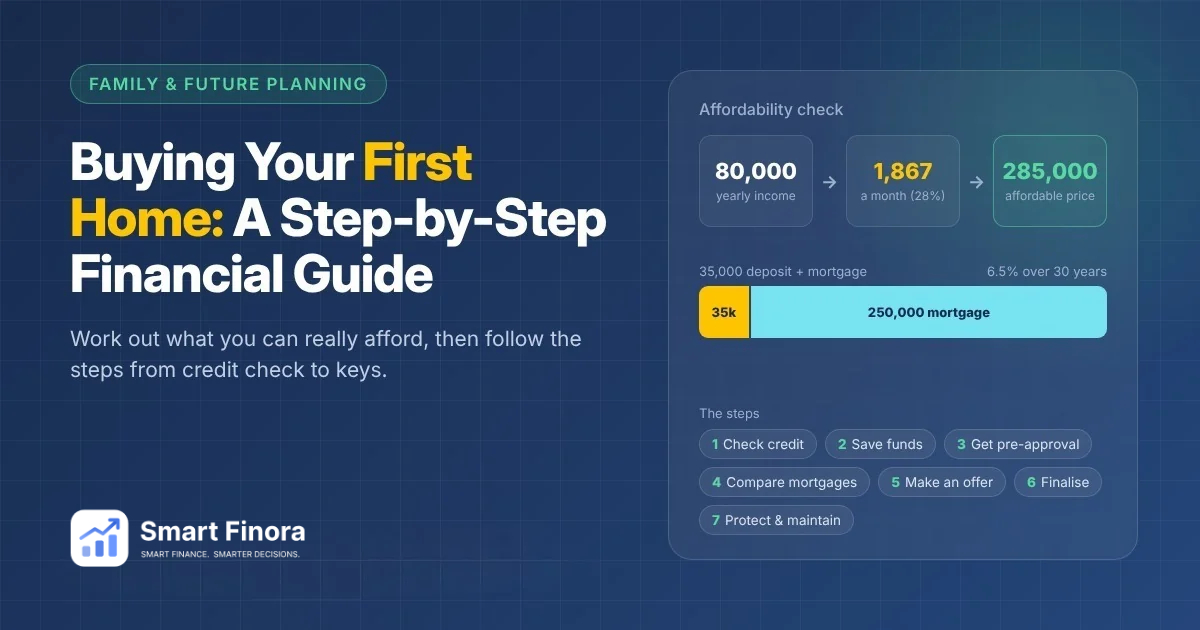
Buying Your First Home: A Step-by-Step Financial Guide

A financial guide to buying your first home: check you are ready, save a deposit, budget for upfront and ongoing costs, see what you can afford and compare mortgages.

3 min read